



Lab Grown Diamonds vs Natural Diamonds: A Buyer Guide
Choosing an engagement ring diamond is not simply a question of which option is better. It is a decision about origin, appearance, budget, documentation, and the meaning you want the stone to carry for years to come. In 2026, both lab-grown and natural diamonds deserve a clear, side-by-side evaluation rather than a one-size-fits-all verdict.
Schedule an appointment to compare your diamond options with a Buchroeders expert.
When comparing lab grown diamonds vs natural diamonds, remember that both have the same chemical composition, crystal structure, and physical properties. The meaningful differences are how each diamond formed, how origin is disclosed, how pricing is established, and which expectations matter most to you. GIA explains the scientific distinction in detail.
If you want a broader foundation before weighing individual stones, begin with Buchroeders' diamond education guide to natural and lab-grown options. This comparison builds on that pillar with a focused look at the questions that most often shape an engagement-ring decision.
Start with the foundation: understanding what laboratory growth changes, and what it does not, makes every later comparison more useful. That distinction begins with the question of whether a lab-grown diamond is a real diamond.
Are lab-grown diamonds real diamonds?
Yes. Lab-grown diamonds are real diamonds, with the same chemical composition, crystal structure, and physical properties as natural diamonds. The meaningful distinction is their origin: natural diamonds formed through geological processes, while lab-grown diamonds are produced in a controlled laboratory environment. Both can be evaluated as diamonds for an engagement ring, but their origin should always be clearly identified. For a closer look at the factors that separate the two, Buchroeders' side-by-side guide to lab-grown and natural diamonds walks through the key distinctions in one place.
Quick answer: If you are comparing lab grown diamonds vs natural diamonds, chemistry does not separate the two. Origin, documentation, personal priorities, and market context are the more useful points of comparison.
What makes a lab-grown diamond a diamond?
A diamond is defined by its material and structure. Lab-grown diamonds have the same diamond crystal structure and physical properties as natural diamonds, rather than simply resembling them. They can be cut, polished, graded, and set in bridal jewelry using the same quality considerations buyers apply to any diamond. The Gemological Institute of America explains that laboratory-grown diamonds have essentially the same chemical composition, crystal structure, and physical properties as natural diamonds. Read the GIA explanation of laboratory-grown diamonds.
The production method is different. Natural diamonds develop deep within the earth over geological time. Lab-grown diamonds are created by replicating the conditions needed for diamond growth in a laboratory. The technology has a substantial history: synthetic diamonds have been produced for industrial purposes since the 1950s, and gem-quality examples were first created in 1970. That history helps explain why laboratory-grown diamonds are an established category rather than an imitation of the material.
How should origin be disclosed?
Clear disclosure is an essential part of an informed purchase. A lab-grown diamond should be identified as laboratory-grown, just as a natural diamond should be identified by its natural origin. The Federal Trade Commission advises sellers to use descriptions that accurately tell shoppers what they are buying, including whether a diamond was mined or made in a laboratory. This is not a statement that one origin is better. It is a standard of transparency.
- Natural diamond: A diamond formed through natural geological processes.
- Lab-grown diamond: A diamond produced in a laboratory with the same fundamental chemical composition and crystal structure.
- Documentation: Review the diamond's grading report and origin description before making a purchase.
- Identification: Some lab-grown diamonds carry a marking that identifies their laboratory-grown origin.
Lab-grown diamonds may be colorless, pink, or blue, and identification markings can help distinguish their origin. The color itself does not answer whether a diamond is natural or lab-grown, so buyers should rely on accurate documentation and professional guidance rather than appearance alone. As with any engagement-ring decision, compare the diamond's quality, the supporting documentation, the setting, and the service included with the purchase.
How do lab-grown and natural diamonds compare in appearance?
For a bridal buyer, the most important visual point is straightforward: a lab-grown diamond and a natural diamond can look remarkably alike when they share comparable quality characteristics. Current lab-grown diamonds can rival high-quality natural diamonds in appearance. The underlying chemistry, crystal structure, and physical properties are the same. Looking at two loose stones across a jewelry counter is not a dependable way to determine how either diamond originated.
Origin and appearance are related buying considerations, but they are not the same thing. A diamond's origin describes how it formed. Its appearance describes what you see when it is cut, polished, and set, including brightness, flashes of color, transparency, and overall presence. If your question is specifically lab grown diamonds vs natural diamonds, visual inspection alone will not provide a reliable answer.
Why can two diamonds look so similar?
Both options can be cut to direct light through the stone and back toward the viewer. In practice, the factors that most influence the face-up look are the 4 Cs: cut, color, clarity, and carat weight. Cut affects the way a diamond handles light. Color affects whether it appears icy white or carries a warmer tone. Clarity concerns the visibility of internal characteristics and surface features. Carat weight affects size and presence, although shape and proportions also influence how large a stone appears from above. If you want to understand how each of the 4 Cs affects what you see, Buchroeders' diamond education hub explains cut, clarity, color, and every factor that shapes a stone's appearance.
These characteristics can create more visible difference between two individual diamonds than origin alone. For example, a well-cut diamond may look lively and bright. While a diamond with less effective proportions may return less light, regardless of whether it formed naturally or in a laboratory. Comparing stones by origin without comparing their cut, color, clarity, and carat information can therefore lead to an incomplete impression.
How is origin identified if appearance is not enough?
Identification depends on professional examination and documentation rather than an unaided glance. Lab-grown diamonds may carry an identification mark that distinguishes their origin, even when their appearance does not make that origin obvious. The Gemological Institute of America explains that lab-grown diamonds have the same fundamental chemical composition, crystal structure, and physical properties as natural diamonds. It also notes that modern synthetic diamonds can rival high-quality natural diamonds visually.
When comparing stones, review the grading documentation alongside the diamond itself. Confirm that the report corresponds to the stone, then compare the recorded cut, color, clarity, carat weight, shape, and stated origin. The documentation gives you information that your eyes cannot reliably establish on their own. Clear origin identification also helps ensure that you understand exactly what you are considering before choosing a setting.
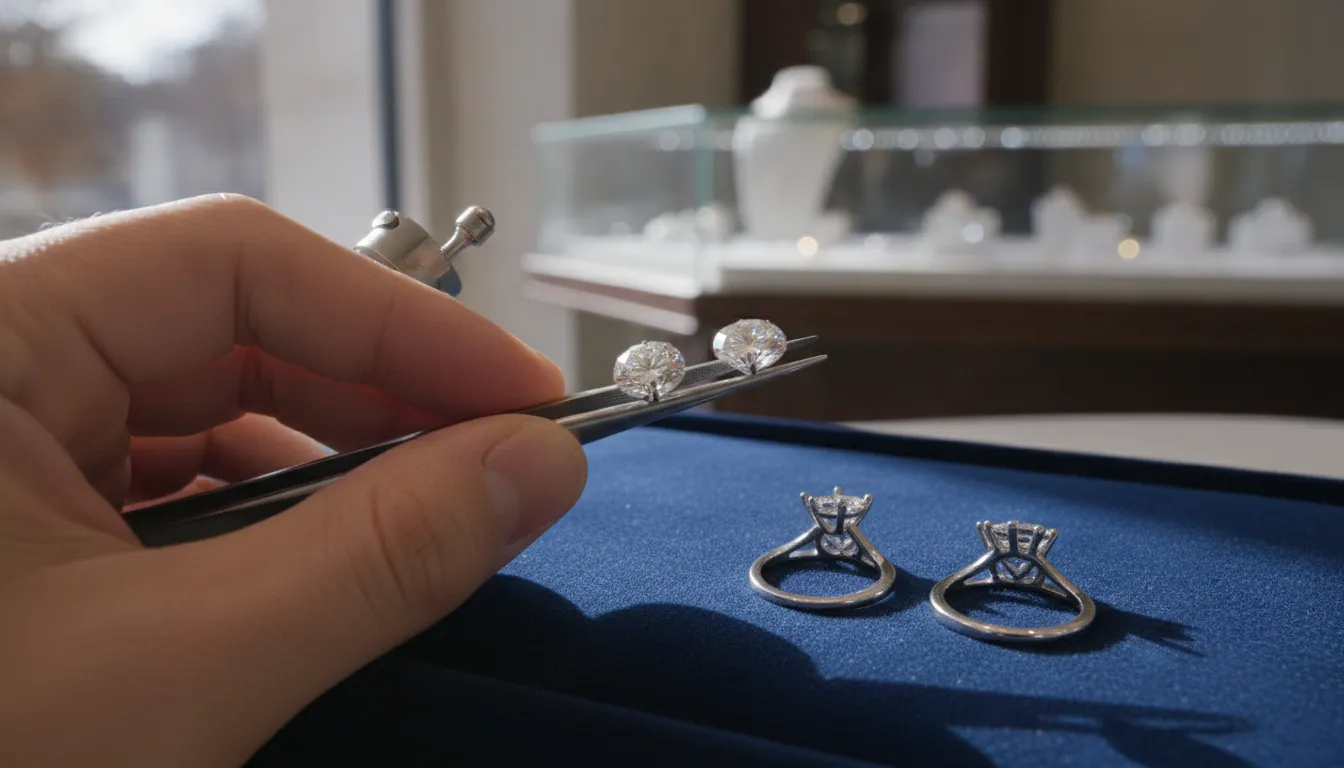
- View each diamond under consistent lighting so the comparison is fair.
- Compare cut quality and light performance before assuming origin explains a visual difference.
- Look at color and clarity in the context of the selected shape and setting.
- Use the grading report to verify carat weight, quality characteristics, and origin.
- Choose the stone whose documented qualities and appearance fit your ring design and personal priorities.
If you are drawn to the visual possibilities of this option, explore Buchroeders' lab-grown diamond engagement rings and compare individual stones by their documented characteristics, not by assumptions about origin.
How Can You Compare Lab Grown Diamonds vs Natural Diamonds on Price in 2026?
Price comparisons are most useful when the two diamonds are genuinely comparable. Start with shape, carat weight, color, clarity, cut quality, grading documentation, and the setting, rather than comparing two stones based only on origin. A lab-grown diamond and a natural diamond can share the same fundamental physical properties, yet their prices may reflect different supply conditions and buyer preferences.
| Comparison factor | Lab-grown diamond | Natural diamond | What to check |
|---|---|---|---|
| Origin | Created through a controlled laboratory process. | Formed through natural geological processes. | Origin should be clearly identified in the description and documentation. |
| Typical pricing relationship | Often priced below a comparable natural diamond in the current market. | Often carries a higher price than a comparable lab-grown diamond. | Use market context as a guide, not a guaranteed percentage or quote. |
| Budget flexibility | May allow a buyer to consider a larger carat weight or a higher combination of color and clarity within a set budget. | May require prioritizing certain 4 Cs, carat weight, or setting details to stay within the same budget. | Decide which qualities matter most before comparing individual stones. |
| Grading and documentation | Should include documentation that identifies the stone as laboratory-grown and describes its quality. | Should include documentation that identifies the stone as natural and describes its quality. | Read the report carefully and confirm that the stone matches the listing. |
| What varies by stone | Cut precision, color, clarity, carat weight, shape, fluorescence, grading, and setting can all affect the final price. | Cut precision, color, clarity, carat weight, shape, fluorescence, grading, and setting can all affect the final price. | Compare like with like, then assess the overall ring and service. |
What does the 2026 market context suggest?
A 2026 market snapshot places many lab-grown diamonds approximately 30% to 50% below natural diamonds of comparable size and quality. Buchroeders' customer education materials describe a broader typical difference of approximately 50% to 70% for comparable stones. These figures should be treated as market context, not as a promise for every shape, grade, or retailer. Actual pricing can shift as availability, demand, grading, and inventory change.
The difference is also not a substitute for examining the stone. Two diamonds with the same carat weight can have noticeably different prices because cut quality, proportions, color, clarity characteristics, shape popularity, and grading documentation are not identical. A well-chosen stone in either category can be a thoughtful centerpiece for an engagement ring, while a less suitable stone may disappoint regardless of its origin or price.
How should you compare the total engagement-ring budget?
Consider the complete ring, not only the center diamond. The setting's metal, design complexity, side stones, craftsmanship, and customization can materially affect the final investment. A buyer who chooses a lab-grown center stone may direct more of the available budget toward size, a detailed setting, or other design priorities. A buyer who prefers a natural diamond may choose a smaller carat weight or simplify the setting to keep the overall ring within the intended range.
Before making a decision, compare quality, price, and service together. That consumer guidance is consistent with the Federal Trade Commission's diamond buying advice, which emphasizes clear distinctions between natural and laboratory-grown stones. For a broader look at available designs, explore Buchroeders' engagement ring collection and compare options using the same criteria.
Explore Buchroeders' Custom Ring Builder to turn your diamond priorities into a personal design.
Which diamond holds its value better over time?
There is no universal answer that guarantees one diamond will hold its value better. Purchase price, market value, emotional value, and long-term expectations are different measures. They should not be treated as interchangeable. A lab-grown diamond may provide more size or flexibility within a current budget. A natural diamond may carry a different meaning for a buyer who places importance on geological origin. The right choice depends on which kind of value matters most to you.
How should you think about purchase price?
Purchase price is the clearest value to compare at the time you buy. It reflects the diamond's quality, size, cut, color, clarity, origin, documentation, and the service included with the purchase. A lower initial price does not automatically mean a better long-term financial outcome, just as a higher price does not guarantee stronger future market value. Compare diamonds on a like-for-like basis and ask what is included, rather than using origin alone as a shortcut.
What is the difference between market value and emotional value?
Market value is influenced by demand, supply, consumer preferences, grading, condition, and broader changes in the jewelry market. Those factors can change over time, so future outcomes are inherently uncertain. No responsible comparison of lab-grown diamonds vs natural diamonds should promise a particular result years from now.
Emotional value is personal and often more durable than a market estimate. The story behind a proposal, the significance of a natural geological origin. Or the ability to choose a larger center stone within a planned budget may shape how meaningful the ring feels to its wearer. That value belongs to your experience and cannot be measured by a price comparison alone.
Why do disclosure and documentation matter?
Origin should be clearly identified before purchase. The Federal Trade Commission advises that diamond sellers describe stones accurately so shoppers understand what they are buying, including whether a diamond is natural or laboratory-grown. Clear documentation also gives you a reliable record of the stone's characteristics and origin. Keep the grading documentation with your important jewelry records and confirm that the stone you are viewing matches its report.
For more context on the fundamentals behind this decision, revisit the Buchroeders diamond education pillar. It can help you connect the comparison between origins with the broader questions of certification, the 4 Cs, and engagement-ring design.
Who should choose lab-grown and who should choose natural?
The best choice depends less on a universal ranking. Think about what you want your engagement ring to represent, how you want to allocate your budget, and which details you will value years from now. Both lab-grown and natural diamonds share the same fundamental chemical composition, crystal structure, and physical properties. Lab-grown diamonds can also rival high-quality natural diamonds in appearance. GIA explains the scientific similarities and differences in origin.
Should you choose lab-grown for size and budget flexibility?
A lab-grown diamond may suit you if you want to prioritize a larger carat size. A particular shape, or a more elaborate setting while staying within a defined budget. It can also be a practical fit when you want to preserve room in the overall ring budget for custom design details or future wedding expenses. The important question is not simply how much the diamond costs. Compare cut, color, clarity, documentation, setting quality, and service together before deciding.
Should you choose natural for geological origin and rarity?
A natural diamond may be the right fit if the stone's geological origin, rarity, and connection to the earth's history are meaningful parts of your story. Some couples value the idea that their diamond formed naturally over an immense span of time. That preference is personal, not a statement that one option is better for every buyer. If the story behind the stone matters as much as its appearance, make origin an intentional part of the conversation from the beginning.
What should every buyer confirm before choosing?
Documentation should make the diamond's identity and characteristics clear. Ask to review the grading report and confirm whether the diamond is natural or laboratory-grown. The Federal Trade Commission advises that sellers distinguish these categories clearly so shoppers understand what they are purchasing. Compare quality, price, and service before buying, and be precise about what you mean by value. You may be thinking about emotional meaning, the quality you receive for your budget, or how market conditions could affect future expectations. Those are different questions. If you still have questions about diamond origin, grading, or what to look for before buying, Buchroeders' frequently asked questions page addresses many of the most common concerns.
How can custom design change the decision?
Custom design can make either path feel distinctly yours. If you already know the setting, proportions, or design details you want, start by deciding which diamond characteristics are non-negotiable and which can flex. You can design your custom engagement ring around the stone and story that fit your relationship, whether that means maximizing size flexibility or giving geological origin a leading role.
- Set a total ring budget, then identify whether size or design flexibility matters most.
- Decide how important geological origin, rarity, and the diamond's story are to you.
- Compare cut, color, clarity, grading documentation, and service, not origin alone.
- Ask clear questions about future expectations without treating any market outcome as guaranteed.
- Confirm that the diamond and setting work together in the custom design you envision.
Schedule a consultation to review lab-grown and natural diamond choices side by side.
Frequently Asked Questions
Are lab-grown diamonds chemically identical to natural diamonds?
Yes. Lab-grown diamonds have the same chemical composition, crystal structure, and physical properties as natural diamonds. Their key distinction is origin: one forms through geological processes, while the other is grown in a controlled laboratory environment. The Gemological Institute of America explains this distinction in its diamond education resources.
Can you visually tell the difference between lab-grown and natural diamonds?
Usually not by looking at a mounted diamond alone. Lab-grown diamonds can rival high-quality natural diamonds in appearance, and cut, color, clarity, and carat weight influence what you see. A grading report and professional testing can identify origin, including identification marks used on some lab-grown diamonds.
Are lab-grown diamonds cheaper than natural diamonds in 2026?
In current market comparisons, lab-grown diamonds are often priced 30% to 50% below natural diamonds of comparable size and quality, although the difference varies by stone. Compare the complete purchase, including cut quality, grading documentation, setting, and service, rather than relying on a percentage alone.
Which diamond type holds its value better over time?
There is no universal outcome to promise. Natural and lab-grown diamonds have different market values and qualities, so consider origin, documentation, quality, and your long-term expectations separately from the emotional value of the ring. The Federal Trade Commission recommends comparing quality, price, and service before buying.
How are lab-grown diamonds made compared to natural diamonds?
Natural diamonds develop deep within the Earth over geological time. Lab-grown diamonds are produced in specialized facilities using controlled growth methods that recreate the conditions needed for diamond crystallization. Both result in diamond material, but origin should be clearly disclosed so you can choose the option that fits your priorities.
Ready to Compare Your Diamond Options?
A personal conversation can help you weigh origin, appearance, documentation, budget, and the setting you want for your engagement ring. Compare lab-grown and natural diamond options with the guidance of Buchroeders Jewelers, then choose the path that fits your priorities.
Schedule an appointment with Buchroeders Jewelers to discuss your options.
