



Lab-Grown Diamond Rings: A Practical Guide for Today's Buyer
Lab grown diamond rings give today's buyer another way to choose a genuine diamond and a finished ring around personal priorities. The stone is made in a controlled laboratory environment, but the buying decision still depends on the same details that make any ring feel right: documented quality, visible light performance, setting design, metal, fit, and confidence in the jeweler. This guide helps you evaluate those details in a sensible order.
Explore Buchroeders' lab-grown diamond ring collection
Quick answer: The best lab grown diamond rings combine a clearly identified lab-grown diamond, a grading report you can review, a setting that suits the wearer's style and lifestyle, and a buying experience that answers your questions before you commit. Compare the complete ring, not a single grade or carat number.
What are lab grown diamond rings?
Lab grown diamond rings are finished rings set with diamonds produced in a controlled laboratory environment. A lab-grown diamond has the same fundamental crystal structure and chemical composition as a natural diamond. Its origin is different, so the stone should be clearly identified as laboratory-grown in its description and documentation.
The two common growth methods are chemical vapor deposition, or CVD, and high pressure, high temperature, or HPHT. The method describes how the diamond was grown. It does not replace the quality questions a buyer should ask about cut, color, clarity, carat weight, treatments, and the finished setting.
The phrase "lab-grown" also matters because it separates a diamond from a simulant. A lab-grown diamond is diamond material. A simulant may resemble diamond but has a different composition and physical properties. For a technical overview of laboratory-grown diamond reports and growth methods, see the Gemological Institute of America's laboratory-grown diamond report information.
How should you evaluate the diamond's report and 4Cs?
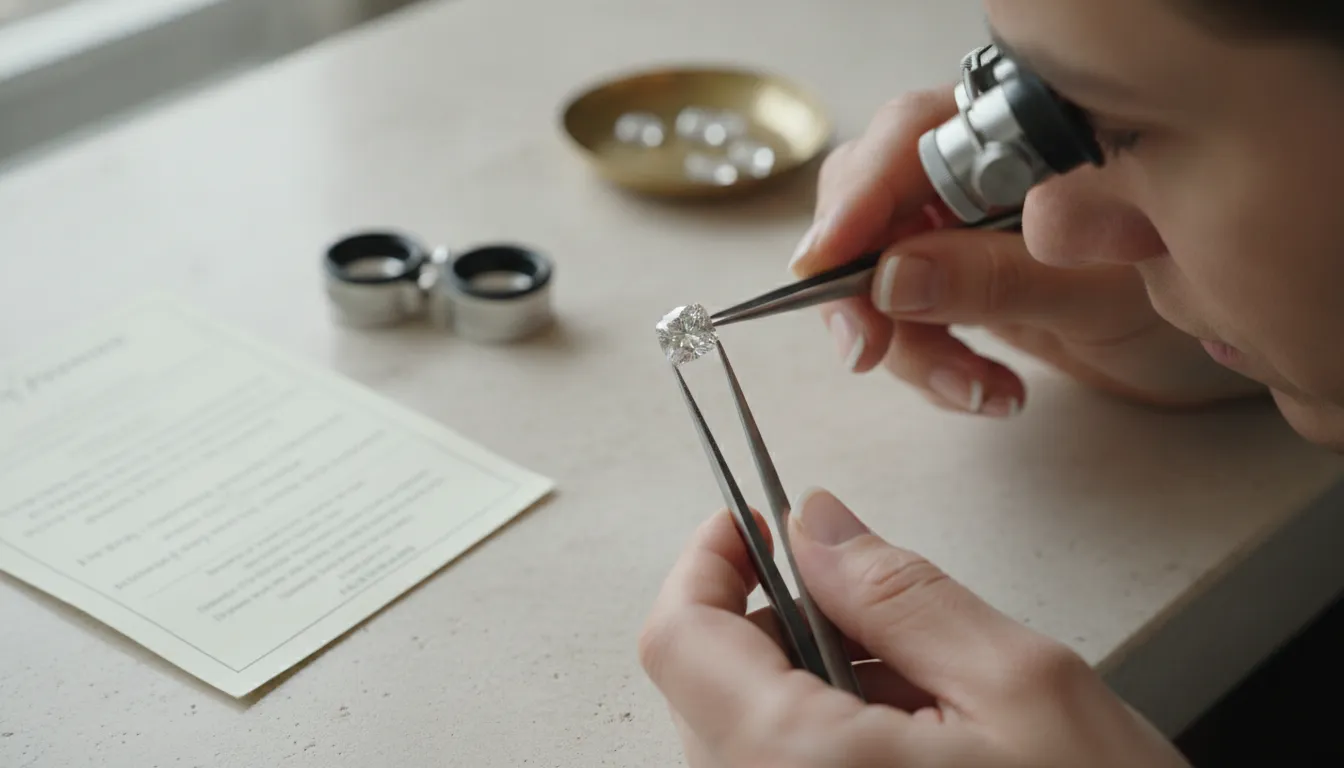
A grading report gives you a consistent starting point for comparing stones, but it is not a substitute for seeing the diamond or asking how it looks in the setting. Review the report alongside the ring's photographs, the jeweler's description, and your own priorities.
What should you check on a lab-grown diamond report?
- Origin: Confirm that the stone is identified as laboratory-grown.
- Report identity: Match the report number to the stone and any laser inscription or verification tool provided.
- Shape and measurements: Check that the report describes the same shape and dimensions as the diamond in the ring.
- Growth method and treatments: Review any disclosed CVD, HPHT, or post-growth treatment information.
- Quality details: Read the cut, color, clarity, carat weight, polish, and symmetry information that applies to the shape.
- Finished-jewelry details: Confirm the metal, ring size, accent stones, and setting description separately from the center-stone report.
The International Gemological Institute's lab-grown diamond report guide explains how reports can document origin, growth information, treatments, proportions, finish, color, and clarity. Use a report to ask better questions, not to turn the purchase into a paperwork exercise.
Which of the 4Cs deserves the closest attention?
There is no universal order for every buyer. Cut often deserves close attention because it affects brightness and sparkle, while color, clarity, and carat weight may matter more depending on the shape, setting, and preferences of the person who will wear the ring.
Cut and shape are not the same. Shape describes the outline, such as round, oval, cushion, emerald, pear, marquise, or radiant. Cut describes how the facets, proportions, symmetry, and finish interact with light. Round brilliant diamonds commonly receive an overall cut grade, while fancy shapes are evaluated through a different set of observations. The Buchroeders guide to the 4Cs of diamonds provides a deeper explanation of these tradeoffs.
Clarity also deserves a practical rather than purely numerical review. A higher clarity grade is not automatically more beautiful to the unaided eye. Ask whether a stone looks clean at normal viewing distance, where any inclusions appear, and how the setting may affect what you see. Color can be more or less noticeable depending on the diamond's shape and the metal surrounding it.
Which ring styles and settings work well for different priorities?
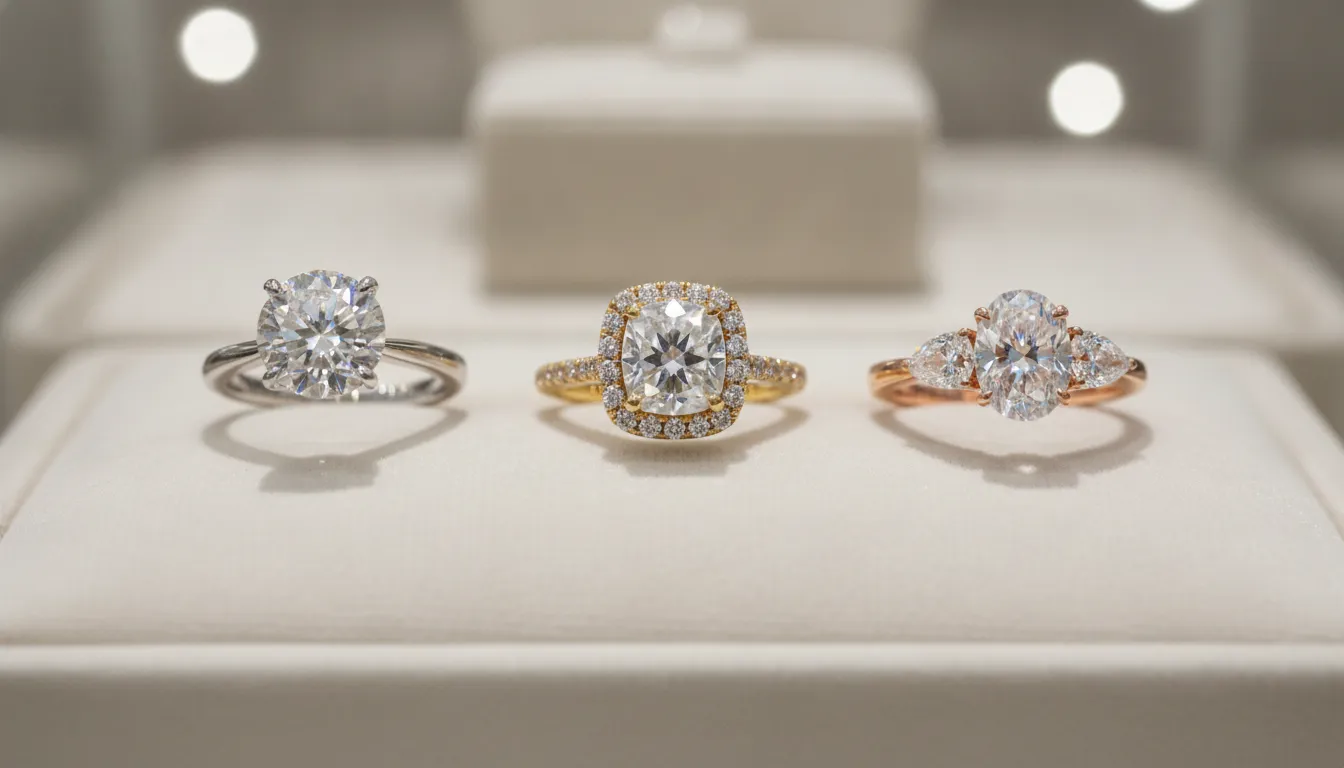
The setting changes how a diamond looks, how protected it is, and how the ring feels to wear. Start with the wearer's habits and preferred look, then compare settings with the center stone rather than choosing a style from a name alone.
| Ring style or setting | What it emphasizes | Questions to consider |
|---|---|---|
| Solitaire | Center-stone shape and clean lines | Does the wearer prefer a focused, timeless look? |
| Halo | A framed center stone and additional sparkle | How does the halo scale with the center stone and hand? |
| Three-stone | A center stone with balanced side stones | Do the proportions and symbolism suit the wearer? |
| Pave or diamond-accented band | Extra light across the shank | Will the texture and maintenance fit everyday habits? |
| Bezel | A smooth metal edge around the diamond | Does the added protection suit the desired profile? |
| Hidden halo or gallery detail | Subtle sparkle from side and top views | Will the design pair comfortably with a wedding band? |
Consider the ring from several angles. A low profile may be comfortable for active hands, while a higher setting can create space for a wedding band. Prongs should hold the diamond securely without distracting from its outline. A bezel can offer a smooth edge, while a halo or pave design adds more small stones to inspect and maintain.
Schedule an appointment to compare lab-grown diamond ring styles with a Buchroeders expert
How do lab grown and natural diamond choices differ?
Lab-grown and natural diamonds are both genuine diamonds, but they differ in origin, documentation language, market context, and the meaning a buyer may attach to the stone's formation. The right choice depends on which of those considerations matters most to you. A neutral comparison is more useful than declaring one option best for everyone.
| Decision point | Lab-grown diamond | Natural diamond |
|---|---|---|
| Origin | Produced in a controlled laboratory environment | Formed through natural geological processes |
| Material | Diamond crystal with the same fundamental composition as a natural diamond | Diamond crystal formed in the earth |
| Documentation | Should identify laboratory-grown origin and report details | Should identify natural origin and report details |
| What to compare | 4Cs, shape, report, setting, metal, fit, and seller support | 4Cs, shape, report, setting, metal, fit, and seller support |
For a fuller side-by-side discussion, read Buchroeders' guide to lab-grown and natural diamonds. This practical guide keeps the comparison brief so you can return to the complete ring: how it looks, how it fits, and whether the documentation and purchase experience meet your expectations.
Be cautious with broad claims about future value, environmental impact, or what every buyer should prefer. Those questions are personal and depend on evidence, market conditions, and individual priorities. Ask for clear information and choose the origin that aligns with your own decision.
Related products

Elevate any occasion with our 0.16ctw Round Lab-Grown Diamond Band in White Gold.
View product
Presenting the 3.03ctw marquise lab-grown diamond engagement ring, crafted in 14K yellow gold.
View product
This 14K yellow gold band features lab-grown round diamonds totaling 0.98 carats in a shared-prong setting.
View productWhat should you ask before buying a lab-grown diamond ring?
Good questions turn an online listing or showroom conversation into a more informed decision. Bring the same checklist to every ring you compare, and ask for answers in writing when the detail affects the purchase.
- What report accompanies the center diamond? Ask who issued it, how to verify it, and whether it identifies laboratory-grown origin.
- Does the report match the diamond in the ring? Confirm the shape, measurements, carat weight, and report number.
- What can I see in normal lighting? Ask to view the ring under more than one light source and while it is moving.
- How is the setting secured? Learn about the prongs, bezel, gallery, accent stones, and any design features that affect care.
- What is the ring's metal and size? Confirm the metal, ring size, width, profile, and whether resizing is possible for that design.
- How will the ring pair with a wedding band? Try a band beside it if the wearer plans to stack rings.
- What care does the finished ring need? Ask about cleaning, inspections, safe storage, and situations where the ring should be removed.
- What support is available after purchase? Review the seller's documented policies for service, sizing, protection, and questions after the ring is delivered.
Buchroeders' custom engagement ring design tool is another option when a ready-made setting is close but not quite right. It lets you consider the setting, diamond, and finished ring as one design instead of forcing a compromise between separate pieces.
How can you choose the right size, metal, and care plan?
Ring comfort is part of ring quality. A setting that looks beautiful but catches on clothing, feels too tall for daily work, or cannot pair with the intended wedding band may not be the right choice. Think about the wearer's routine before settling on a design.
White gold, yellow gold, rose gold, and platinum create different visual relationships with the diamond and the wearer's skin tone. The metal also influences weight, feel, maintenance, and the appearance of the setting. View the same or similar design in more than one metal when possible, and ask how the chosen metal should be cared for over time.
Confirm the ring size through a reliable measurement rather than guessing from a ring that may fit another finger. Finger size can change with temperature, time of day, and activity. A professional fitting is the strongest starting point, especially for an important purchase or a design with a wide band.
Finally, ask how the ring will be protected and serviced. A jeweler should be able to explain routine cleaning, inspection, and repair considerations in clear terms. That conversation is part of buying with confidence, not an afterthought.
Schedule a consultation to review your lab grown diamond ring questions in person or virtually
Frequently Asked Questions About Lab Grown Diamond Rings
Are lab grown diamond rings made with real diamonds?
Yes. A lab-grown diamond is a real diamond with the same fundamental crystal structure and chemical composition as a natural diamond. The difference is origin: it is produced in a controlled laboratory environment rather than formed through natural geological processes. Its laboratory-grown origin should be clearly disclosed in the description and documentation.
Do lab grown diamond rings come with grading reports?
Many lab-grown diamonds are accompanied by a grading report, but the exact document depends on the stone and grading laboratory. Ask to review the report before buying, confirm the report number matches the diamond, and check that the document identifies laboratory-grown origin and relevant quality details.
What is the most important factor in a lab grown diamond ring?
There is no single most important factor for every buyer. Cut and visible light performance deserve close attention, but the best decision also considers shape, color, clarity, carat weight, setting security, fit, metal, documentation, and the support available from the jeweler.
Can I choose a custom setting for a lab-grown diamond?
Yes, a custom design can be a useful option when a ready-made ring does not fit the desired style, metal, proportions, or wedding-band pairing. Buchroeders' custom ring process lets you discuss the design, select a diamond, and review a 3D rendering before the ring is created.
How should I compare lab grown diamond rings?
Compare complete rings under consistent lighting. Review each center-stone report, confirm the setting and metal, assess the diamond's visible performance, check the fit and profile, and ask the same care and support questions for every ring. A single carat or clarity number cannot describe the whole purchase.
Book your appointment with Buchroeders Jewelers to compare lab grown diamond rings with an expert
Choosing among lab grown diamond rings should feel like a considered design decision, not a race to maximize one specification. Start with clear documentation, look at the diamond in real light, compare settings and metals, and ask how the finished ring will fit the wearer's life. When you want help weighing those details, the Buchroeders team can guide you through ready-to-shop and custom options.
