



Women's Wedding Bands: The Ultimate Buying Guide
Choosing women's wedding bands means balancing personal style with decades of daily wear. This single piece of jewelry sits on your finger through every moment of your marriage. From the moment you say "I do," your wedding band becomes part of your story.
High-quality women's wedding bands must combine timeless beauty with excellent daily strength to survive decades of active wear on your hand. Finding the perfect ring involves picking a strong metal, choosing a style that matches your engagement ring, and selecting a comfortable fit. According to the Gemological Institute of America, fourteen-karat and eighteen-karat gold offer excellent durability, while platinum provides high-end strength. Our expert local jewelers help you compare these fine metals, explore sparkling diamond options, and select a band that fits your personal budget. Whether you prefer a classic plain gold band or a sparkling diamond ring, this complete guide will help you buy with confidence.
With so many choices available, the decision can feel overwhelming. Do you choose white gold or platinum? A diamond band or a simple metal ring? How do you find a ring that matches both your unique personal style and your daily lifestyle? In this guide, we walk through everything you need to know, from metal types and diamond options to sizing, style, and budget. To help you make the perfect choice, we will start by choosing the perfect metal for your wedding band.
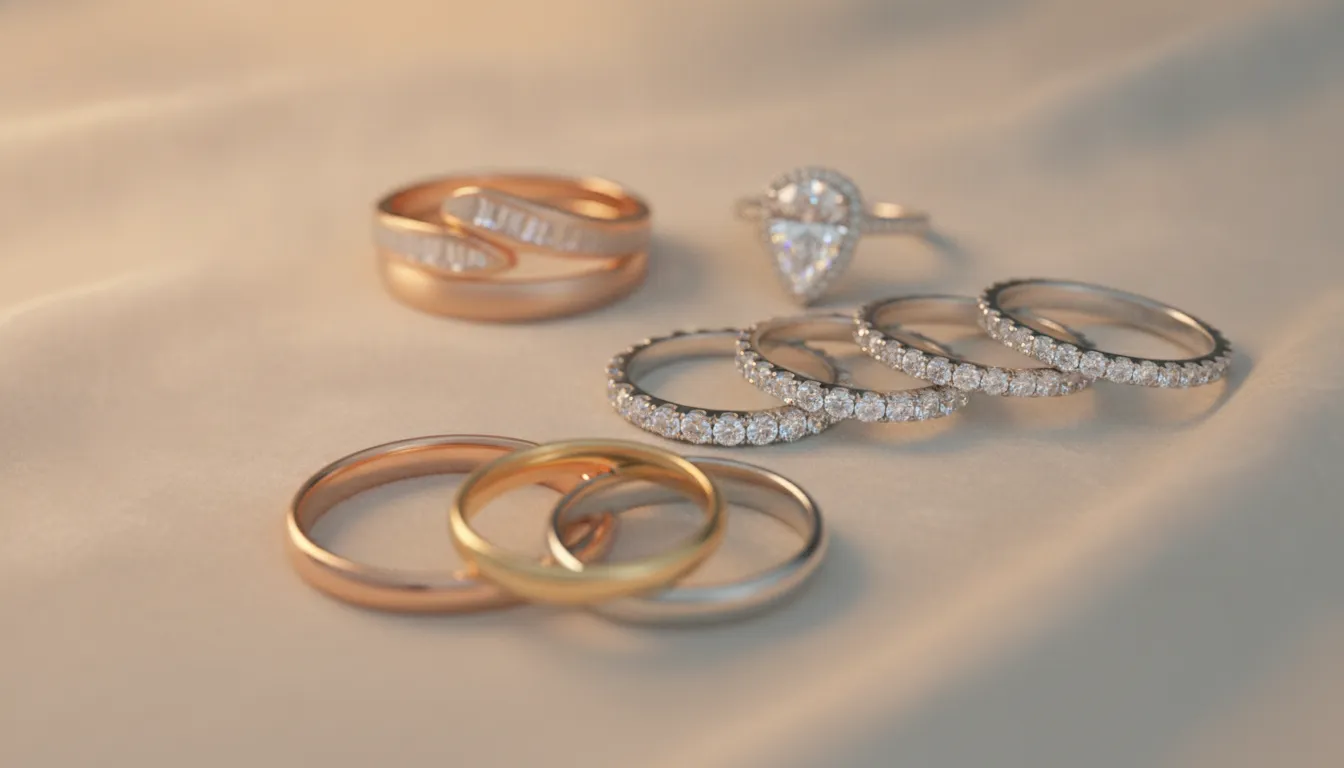
Choosing the Perfect Metal for Your Wedding Band
Choosing the right metal is a key step in finding your perfect ring. Your choice affects how the band looks, how much care it needs, and how it feels on your skin. When you look at women's wedding bands, you will see a few precious metals. The best option for you depends on your style, your work, and your daily habits.
Gold purity and color options
Gold is a classic choice for a band, but pure gold is too soft for daily use. Because of this, jewelers mix pure gold with other metals to make an alloy. For instance, 14k gold strength is great because it has more alloy metals. This popular metal needs very little care and holds up well to daily bumps and scratches.
Pure 24k gold is not a good choice for daily bands because it is too soft. If you want more gold, 18k gold is strong enough for daily wear. It has a rich color and may only need quick polishing to clear light scratches.
Gold also comes in three colors. Yellow gold has a warm glow, while rose gold gets its pink hue from copper. White gold is common, but it needs extra care. To keep it shiny, you must have a jeweler coat it with rhodium every few years.
When choosing between 14k and 18k gold, you should think about color and price. Since 14k gold has less pure gold, it costs less and has a slightly lighter yellow color. 18k gold has more pure gold, which gives it a deeper yellow hue, but it also costs more. Both choices are great for daily wear, but 14k is the most popular choice for brides on a budget.
Platinum and its lasting strength
Platinum is a top choice if you want a strong metal. This rare, white metal is naturally hypoallergenic, making it great for sensitive skin. Unlike white gold, it does not need plating, though it will develop a soft finish called patina over time. You can easily have this polished off to restore its true shine.
Platinum is dense, so a platinum band will feel heavier on your hand. It is also more expensive than gold because more pure metal is used to make the ring. When gold is scratched, a tiny bit of metal is lost. When platinum is scratched, the metal is simply shifted, which is why it keeps its weight over decades of wear.
Metals to avoid for daily wear
While you may see other metals online, some are not fit for a daily wedding band. For example, sterling silver is rarely used because it is too soft and tarnishes quickly. It scratches easily and will not last as long as gold or platinum. You want your ring to last a lifetime, so it is best to stick with fine precious metals.
Diamond Wedding Bands vs. Plain Bands: Which Is Right for You?
Finding the right style among diamond wedding bands involves weighing both looks and daily use. Your choice of women's wedding bands affects your budget and how much care the ring needs over time. Both options offer great beauty, but they serve their own daily needs and lifestyles.
Comparing the Price of Diamond and Plain Rings
Price is often the first thing couples look at when they shop. A simple comfort fit plain band can start at about $390. This makes plain bands a budget-friendly choice for many brides. In contrast, half-eternity lab diamond bands often run between $690 and $1,990, because adding stones raises the cost. If you select a natural diamond band, the price can go much higher based on the stone size and grade.
If you choose a ring with gems, you can pick between lab-grown and natural diamonds. Both options have the same makeup and shine. Natural diamonds are rare and hold classic value, while lab-grown options offer a larger look for less money. There is no single winner here, so you should pick the one that matches your own taste and goals. Our team can show you both options in person so you can see how they look.
Daily Wear and Maintenance Needs
How you use your hands each day should guide your choice. Plain bands are tough and do not have stones that can fall out. To keep your band safe, you should learn about strong metal options before you buy. A plain band is a great choice if you work with your hands, play sports, or do heavy tasks. You will not have to worry about losing a stone while working or cleaning.
Diamond rings need more care to stay in top shape. The small metal claws that hold each stone can snag or loosen over time. You will need to take a diamond band to a jeweler for prong checks at least once a year. This check helps prevent lost stones and keeps your ring secure.
Style and Stacking Options
For many brides, the choice comes down to style. Sparkly eternity bands are great for stacking with an engagement ring. They add extra shine and make your bridal set stand out. But a plain metal band is easy to wear daily, because it matches any look and never goes out of style. Many brides choose a plain band for daily tasks and keep their diamond band for special events.
| Band Type | Price Range | Maintenance | Daily Wear |
|---|---|---|---|
| Plain Bands | About $390 | Occasional polish | Tough metal, best for active work |
| Diamond Bands | $690 to $1,990 | Annual prong checks | Needs care, best for stacking |
How to Match Your Wedding Band With Your Engagement Ring
Finding a band to go with your engagement ring is a key step. You want a look that matches your style and fits your daily life. When you shop for matching women's wedding bands, you must check how the metals, shapes, and styles work as a pair.
Metal Match and Contrast
The metal you pick sets the tone for your bridal set. Many brides choose a band in the same metal as their ring to keep the look seamless. For instance, if you have a white gold ring, you may want a white gold band. This creates a uniform look that lets your main diamond stand out. If your engagement ring is yellow gold, a yellow gold band will highlight the warm metal. This is a classic look that has been loved for ages.
But you do not have to match metals. Mixing yellow gold with platinum is a planned choice that makes your set unique. Keep in mind that white gold needs extra care. The GIA states that white gold can require replating with rhodium every few years to stay bright. Yellow gold and platinum do not need this care.
Curved and Straight Ring Shapes
The shape of your band depends on how high your center gem sits. If your diamond sits high off your finger, a straight band can slide right underneath it. This lets the two rings sit flush against each other. It is a classic look that is easy to wear and pair.
If your ring is low-set, the main diamond basket will block a straight band. This leaves a gap between the two rings. Some brides like the gap because it highlights each ring on its own. Others prefer the clean look of a curved band that hugs the center stone. These curved bands have a slight dip in the front to nestle around your ring setting.
The Ring Stack Trend
You do not have to limit yourself to just one wedding band. Many brides now choose to stack several bands around their engagement ring. This ring stack trend lets you play with different styles, colors, and widths over time.
You can start with one simple band and add more for big events like a first anniversary. You can also mix thin diamond bands with thick plain bands. If you need help, you can learn how to choose your women's wedding band with expert tips. A chat with a local jeweler can help you find a style that fits your hand.
Wedding Band Styles for Every Bride
Choosing a wedding band is a special step. At Buchroeders Jewelers, we help you find a piece that fits your style. We carry a fine range of women's wedding bands to suit any taste. The style you choose will define how your ring set looks and feels every day.
Classic and diamond eternity styles
Classic plain bands are clean and timeless, focusing on the pure shine of gold or platinum. You can choose a comfort fit band in a width that matches your ring for a seamless look. This simple design is best for brides who want a sleek band. It pairs well with any diamond shape, from a round stone to a sleek emerald cut, while creating a clean contrast.
Diamond eternity bands feature gems that go all the way around the ring to show a love that never ends. To make size changes easy, a half-eternity band has diamonds on the top half only. GIA guidelines show that metals like 14k gold offer great strength for daily wear (GIA everyday wear guide). These sparkling bands are perfect for brides who want bold shine, adding instant glamour to any bridal set.
Curved and stackable options
Curved and contoured bands are made to fit close to your engagement ring. Some engagement rings have large center stones that prevent a straight band from sitting flush against them. A curved band arches around the center gem so the two rings sit tight without any gap. This look is perfect for pear, oval, or marquise cut center diamonds.
Stackable bands let you build a unique bridal set over time by mixing metals, widths, or styles. Many brides add new bands to mark milestones like an anniversary or the birth of a child. This style is fun, flexible, and fits any lifestyle. To learn more about choosing your ring set, read our guide on how to choose your women's wedding band.
Vintage-inspired designs
Vintage bands bring the charm of the past to your hand with detailed metal work. These designs feature milgrain, which is a tiny beaded edge, as well as filigree or engraved patterns. This style is best for brides who love romance and old-world art. Vintage bands pair nicely with heirloom rings or add unique charm to a simple solitaire.
These rings use fine details to stand out without needing large diamonds. They offer a classic, antique feel that is both bold and soft. At Buchroeders, our custom team can even add these details to a new ring. This is a great way to make a modern band feel like a family heirloom.
Finding your wedding ring should be a joyful path. Buchroeders carries a hand-picked range of women's wedding bands to suit every style. Our team of experts is ready to help you in our showroom or online. We will guide you to the perfect band for your taste and lifestyle.
Wedding Band Sizing and Fit: A Step-by-Step Guide
Finding the correct ring size is a vital part of choosing your bridal rings. When you plan how to choose your women's wedding band, getting the right fit is key. A good fit means the ring stays secure but slips off with slight resistance.
Steps to Find Your Ring Size
Your fingers change size during the day. Follow these steps to find the perfect fit for women's wedding bands:
- Visit a local jeweler to get sized because your hands can swell from heat or exercise.
- Account for your knuckle size so the band can slide over the joint with ease.
- Decide between a comfort fit and a standard fit to see which feels best on your skin.
- Check the fit across several days to make sure the ring feels snug but not tight.
Comfort Fit vs Standard Fit
The inside edge of a ring greatly affects how it feels on your hand. A standard fit band is flat along the inner surface, which sits flush against your skin. In contrast, a comfort fit band has a curved inside edge. This curved shape cuts friction and makes the band easy to slide over your knuckle. Many brides prefer a comfort fit for wider bands because it lets the skin move more freely.
Hypoallergenic Metals and Resizing
Your choice of metal can also impact how comfortable your ring feels. Some gold rings contain nickel, which can cause itchy skin. If your skin is sensitive, platinum is a safe choice. According to the Gemological Institute of America, platinum is a highly durable metal known for its strength. A hypoallergenic metal keeps your band comfortable for a lifetime.
It is common for your finger size to shift over the years. You may need to resize your band if it becomes too tight or too loose. But you should wait before you make any changes. Cold weather can make your fingers shrink, while hot weather can make them swell. If your wedding band is snug but still slips over your knuckle, it is likely the perfect fit. If the ring slips off too easily or leaves painful marks, visit a jeweler to resize it.
Budget Guide: What to Expect When Buying Women's Wedding Bands
Women's wedding bands come in a wide range of prices to fit nearly any budget. A simple band in 14k gold starts around $300 to $500. Diamond bands and designer pieces cost more, with many falling between $800 and $3,000. Full-eternity diamond bands with higher carat weights can reach $5,000 or more.
What affects the price
The biggest factors are metal type, karat weight, and whether the band includes diamonds. Platinum costs more than gold due to its density and rarity. White gold with rhodium plating offers a similar look at a lower price point. Diamond bands cost more than plain bands because of the added gemstone weight and labor to set each stone.
Lab-grown diamonds offer a way to get the look of a diamond wedding band at a lower price than natural diamonds. They are chemically identical and just as durable. Buchroeders carries both options so you can choose what fits your style and budget.
Getting the best value
Buying from a trusted local jeweler means you get personalized service, quality assurance, and support from real experts. Unlike big national chains, Buchroeders Jewelers takes the time to understand your style, show you options in your price range, and help you find a women's wedding band you will love for a lifetime.
Frequently Asked Questions
How do I choose the perfect women's wedding band?
Start with the metal. Think about your daily habits and any skin sensitivities you may have. Then look at your engagement ring setting. A high-set ring works with many band styles, while a low-set ring may need a curved band. Next, pick a width that feels comfortable on your finger. Finally, set a budget. A local jeweler can guide you through each step.
What is the difference between women's wedding bands and anniversary bands?
A wedding band is exchanged during the marriage ceremony and symbolizes your commitment. It is usually designed to stack with your engagement ring. An anniversary band is given later to mark a marriage milestone. These rings often feature larger diamonds or unique styles that you can wear on any finger.
Are lab-grown diamonds a good choice for wedding bands?
Yes, lab-grown diamonds are an excellent option. They share the exact physical and chemical traits of natural diamonds. Because they cost less, they let you get a larger stone or a more detailed style for your budget. Neither type is better, so your choice depends on your personal preference.
Can women wear wedding bands alone?
Many women choose to wear their wedding bands without an engagement ring. This is a practical choice for work, travel, or hands-on hobbies. A simple band or an eternity ring with diamonds can look beautiful on its own. It is a great way to showcase a single, timeless piece of jewelry.
What metal is best for women's wedding bands?
The best metal depends on your style, daily habits, and budget. Platinum is very strong and does not change color, though it can cost more. According to the Gemological Institute of America, 14k gold is also an excellent choice. It offers great durability for daily wear and needs very little upkeep. Yellow, white, and rose gold are all great choices.
How do you wear a wedding band and engagement ring together?
The traditional way is to wear your wedding band closest to your heart, with the engagement ring above it. Many brides stack them on the same finger. If your engagement ring has a tall setting, a curved band can nestle against it for a flush fit. Stackable bands let you add more rings over time for a custom look.
Ready to Choose Your Perfect Women's Wedding Band?
Your wedding day is coming fast, and waiting to choose your wedding band can lead to rushed choices, missed shipping deadlines, or stressful resizing issues. Starting your selection process today gives you plenty of time to explore beautiful matching styles and find a comfortable fit that lasts your entire lifetime. Do not wait until the last minute and risk settling for a plain ring that does not match your unique lifestyle or personal design taste.
Ready to find the ring of your dreams? Call (573) 443-1457 to browse our curated selection of women's wedding bands in person or online today. Our warm, welcoming, and experienced jewelry experts are always here to help you find your perfect match.
