



Princess Cut vs Round Brilliant Diamond Guide
Choosing an engagement-ring diamond is not simply a matter of picking the shape that sparkles most. The outline, face-up spread, setting, and way the diamond handles light all affect how the finished ring looks and feels. Your preferred balance of brilliance and geometric character matters just as much as the grading details.
Explore custom engagement ring design
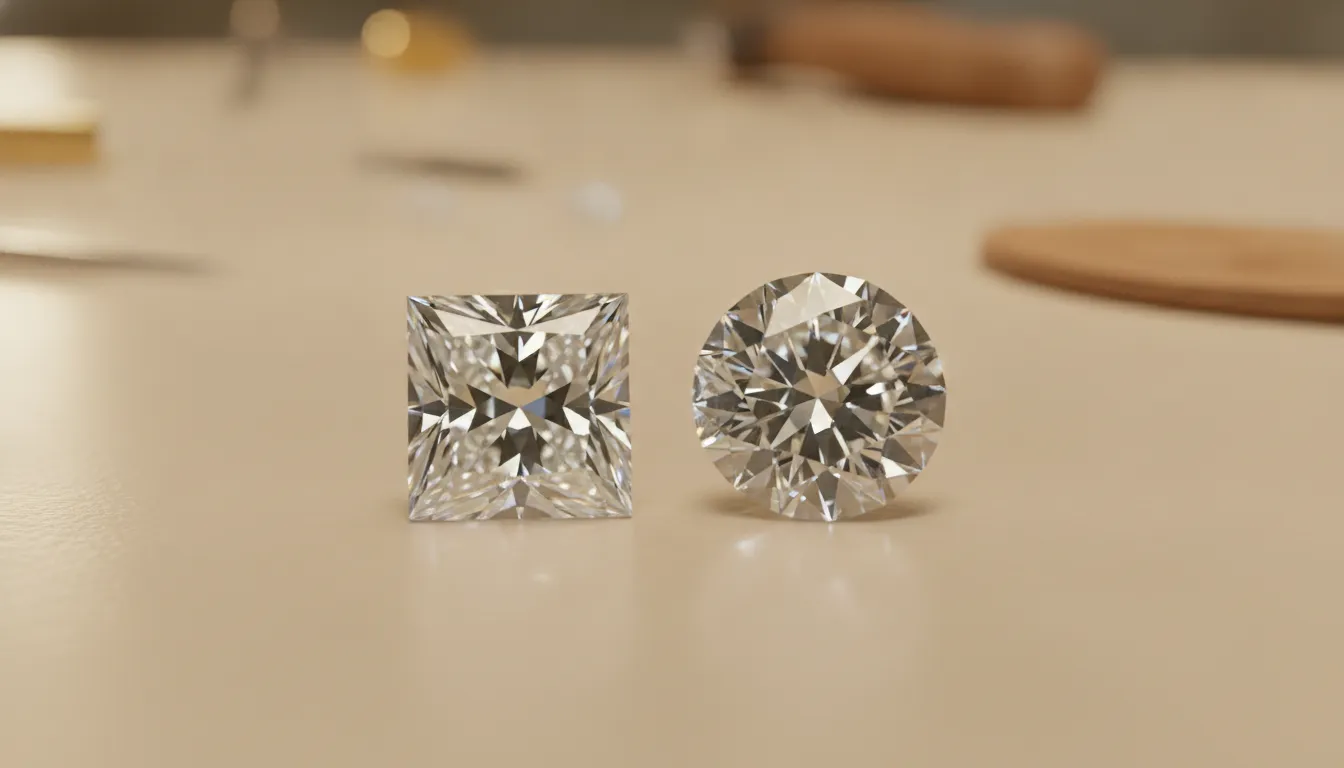
When comparing a princess cut vs round brilliant diamond, neither is universally better. Round brilliant diamonds are known for lively, broad sparkle, while princess cuts offer a crisp, modern outline and can provide strong value. The right choice depends on your priorities, proportions, and setting.
Start with the fundamental difference between these two brilliant-style designs, then compare their light performance, apparent size, value, and setting considerations. Buchroeders' diamond education resources can help you evaluate the details with confidence.
What Distinguishes a Princess Cut From a Round Brilliant Diamond?
The clearest difference is visible before you compare sparkle: a princess cut presents a crisp, geometric outline, while a round brilliant creates a continuous circular silhouette. These are not simply two names for the same cut. Shape describes the diamond's outline, while cut describes how its facets, proportions, and angles are arranged to interact with light.
According to GIA grading terminology, a princess cut is a square modified brilliant. The word "modified" matters because its brilliant-style faceting has been adapted to a square or rectangular outline. Although many princess cuts appear square, they can also be rectangular or tapered while remaining modified brilliants. That range gives the shape a tailored, architectural character, especially in an engagement ring with clean lines.
A round brilliant, by contrast, is built around a circular outline and a highly established brilliant-cut design. A standard round brilliant has 57 or 58 facets, depending on whether it has a culet. It is widely treated as the reference point for diamond brilliance and light reflection, which helps explain its enduring appeal. In a ring, its curved perimeter tends to feel classic and fluid, pairing naturally with many band profiles and setting designs.
How do their facet patterns change their identity?
The princess cut's square outline creates a strong contrast between its four sides and corners. From across the hand, that geometry can look modern, tailored, and distinctive. The round brilliant offers a more symmetrical, uninterrupted face-up pattern, with no corners competing for attention. Its circular outline can read as softer and more traditional, even when the setting itself is contemporary.
When comparing the two, avoid treating shape as a shortcut for quality. A princess cut and a round brilliant can each be beautifully made, but their visual identities are different. If you are drawn to defined corners and a structured silhouette, princess may feel right. If you prefer a circular outline and the established look of a brilliant diamond, round may be the better starting point. The next question is how those designs handle light and create sparkle.
Which Cut Has More Sparkle, Princess or Round Brilliant?
There is no single answer for every diamond. A round brilliant is the standard reference for brilliance and light reflection, and a well-cut round is prized for lively, broad sparkle. A princess cut can also be exceptionally bright, but its facet arrangement varies more from stone to stone. That variation makes the individual diamond especially important to evaluate.
What does sparkle actually mean?
Diamond professionals use several terms to describe the way a stone interacts with light. Brilliance is the total amount of white light reflected back to the viewer. Fire is the dispersion of white light into spectral colors, creating flashes that can appear rainbow-like. Scintillation is the changing play of light seen as the diamond or the wearer moves. A diamond can show a different balance of these effects depending on its proportions, facet design, lighting, and movement.
Shape and cut style both influence how a diamond reflects light. Round brilliants generally have a more established facet pattern, with the standard design containing 57 or 58 facets. Their symmetry is critical to light performance, so uneven alignment can affect the way the stone returns light. You can learn more about how diamond cut affects brilliance before comparing individual stones.
Why can princess sparkle look different?
Princess cuts are modified brilliants, but their facet number and arrangement can vary widely. That difference can change both the amount of sparkle and its pattern. One princess cut may show crisp, geometric flashes, while another may produce a softer or more varied appearance. Symmetry and proportions still matter, even without a universally standardized cut-grade scale for fancy shapes.
When comparing the two, view each diamond in several lighting conditions and watch it move. Look for balanced brightness, appealing flashes of color, and a pattern you enjoy rather than choosing by shape alone. The strongest choice in the princess cut vs round brilliant diamond decision is the stone whose light performance matches your visual preference and setting plans.
Related products

Presenting the 7.27ctw Round Brilliant Diamond Pavé Engagement Ring, crafted in luxurious platinum.
View product
Shop diamond rings in-store or online at Buchroeders Jewelers.
View product
Featuring a classic round brilliant center stone, two tapered baguette diamonds are precisely cut to frame it.
View productWhich Diamond Looks Larger for the Same Carat Weight?
Carat describes a diamond's weight, not the amount of surface area visible from above. That distinction matters when comparing a princess cut and a round brilliant. Two diamonds with the same carat weight can have different face-up dimensions. So the one that looks larger on the hand is not necessarily the one that weighs more.
Princess cuts can sometimes appear smaller for their weight because much of the stone's mass sits below the girdle in the pavilion. This deep, pyramid-like structure contributes to the shape's design, but it can leave less area visible from the top than another diamond with a similar carat weight. Pavilion depth, crown proportions, and the balance between the stone's length and width all influence the result.
What should you compare besides carat?
Ask to see the diamond's measurements, not just its carat total. Compare length and width, then consider how those dimensions work together. A square princess cut should ideally have a length-to-width ratio no greater than 1.05:1. However, princess cuts may also be rectangular or tapered, so a buyer who prefers more finger coverage may intentionally choose a different outline.
Rounds and princess cuts also distribute their visual presence differently. A round brilliant has a curved outline that can read as broad and balanced, while a princess cut fills a setting with straight edges and corners. Neither shape always looks larger. Face-up appearance depends on shape, proportions, and symmetry, and a well-proportioned stone in either style can make a strong visual impression.
When comparing the choice of diamond shape, view stones side by side and check their actual measurements. This approach gives you a more reliable sense of coverage than using carat weight alone, while keeping your decision grounded in the outline and proportions you prefer.
How Does Value Compare for a Princess Cut vs Round Brilliant Diamond?
Princess cuts often cost less than round brilliants of similar size and quality. One reason is cutting yield: a princess cut can retain more of the original rough diamond during shaping. While a round brilliant typically requires more material to be removed. Demand also influences value. Round brilliants have a long-established position as the classic engagement-ring choice, which can contribute to stronger market pricing. That difference does not make one shape a better purchase. It means your budget may be allocated differently depending on the outline and light performance you prefer.
| Consideration | Princess cut | Round brilliant |
|---|---|---|
| Typical pricing relationship | Often costs less than a round of similar size and quality. | Often commands more because of established demand and cutting requirements. |
| Cut assessment | No universally standardized cut-grade scale for fancy shapes, so careful visual review matters. | Has an established cut-grade system that can make comparisons more structured. |
| What to compare | Color, Cut, Clarity, and Carat, along with the diamond's face-up appearance and light performance. | |
Do not judge value from carat weight or shape alone. Cut quality has a major effect on brilliance, fire, and scintillation, so a lower price is not meaningful if the stone looks dull or uneven. A round brilliant's established cut grade can provide a useful starting point, but you should still examine symmetry and appearance. With a princess cut, the absence of a standardized cut-grade scale makes side-by-side inspection especially important.
Use the understanding diamond quality guide to review the 4Cs together. Comparing Color, Cut, Clarity, and Carat on an equivalent basis will give you a clearer picture of value than focusing on a single specification.
Which Setting Styles Work Best for Princess Cut Diamonds?
Princess cut diamonds bring clean lines and pointed corners to an engagement ring, so the setting should be chosen with protection as well as appearance in mind. The corners are the most vulnerable areas of the shape and can be susceptible to chipping if they are left exposed. Because princess cuts typically have sharp 90-degree corners, they require setting techniques that secure those points carefully.
How do V-prongs protect the corners?
V-prongs are shaped to wrap around a princess cut's pointed corners. They can help shield the areas most likely to receive an impact while preserving the square outline that makes the shape distinctive. This is often a practical choice for someone who wants a clean, defined look without surrounding the entire diamond with a halo. The exact prong design still depends on the stone's proportions and the jeweler's setting plan. So protection should be evaluated on the individual diamond rather than assumed from the setting name alone.
Can a halo make a princess cut more secure?
A halo can provide an additional frame around the center stone and may help protect its corners when designed appropriately. It also changes the ring's visual scale and creates a more detailed appearance. A bezel or partial bezel may offer another protective approach. But its suitability depends on how the diamond is measured, how much of the edges need coverage, and the desired look. Shared-prong details can be attractive in a multi-stone design, yet exposed corners and contact points require particular attention. These are design decisions, not automatic guarantees of durability.
What else should you consider besides protection?
Consider the ring's profile, or how high the center diamond sits above the finger. A lower profile may feel more practical for daily wear, while a higher profile can create room for a wedding band to sit closely beneath the engagement ring. The band itself matters: compare its width, curve, and setting details with the princess cut's square outline before finalizing the design.
Round brilliant diamonds generally offer softer outlines and are commonly paired with prongs, halos, bezels. Or solitaire designs, but the best choice still depends on the exact stone and your wear preferences. For guidance on combining protection, profile, and band compatibility, explore custom engagement ring design and compare the finished settings in person before deciding.
How Should You Choose Between These Two Diamond Shapes?
Choosing between a princess cut vs round brilliant diamond comes down to the details that matter most when you look at and wear the ring. Neither shape is automatically right for every buyer. Use the comparison as a starting point, then let your preferred sparkle, proportions, setting, and daily routine guide the decision.
- Decide what kind of sparkle you want. A round brilliant is a familiar reference point for brilliance and light reflection, with 57 or 58 facets in the standard design. A princess cut can show a more geometric pattern, and its facet arrangement may vary significantly from one stone to another. Watch each diamond as it moves. Brilliance is the white light reflected toward you, scintillation is the sparkle that appears with movement, and fire is the display of spectral colors. If you want to explore the technical side, read about how diamond cut affects brilliance.
- Compare face-up measurements, not carat weight alone. Shape, proportions, and symmetry all influence how large a diamond looks from above. Much of a princess cut's weight can sit in its pavilion, so it may appear smaller than another shape with a similar carat weight. Compare the actual length and width of both stones. For a square princess cut, a length-to-width ratio no greater than 1.05:1 is a useful proportion guideline, while rectangular princess cuts create a different visual effect.
- Review all four quality factors. Evaluate Color, Cut, Clarity, and Carat for either shape. Cut strongly affects light performance, but round brilliants have a standardized cut-grade scale, while princess cuts do not. That makes a careful visual review especially important for a princess cut. Our guide to choosing your perfect diamond shape can help you organize the style decision before comparing individual stones.
- Plan for protection and your lifestyle. Princess cut corners are vulnerable and should be protected by the setting. Ask how the design will shield those sharp corners, whether with V-prongs or another appropriate approach. Consider how active your daily routine is and whether the ring will be worn alongside a wedding band.
- Try both shapes on and ask questions. Face-up measurements and grading information are valuable, but your hand will reveal how each outline feels and looks in a setting. Buchroeders provides personalized education and design guidance, so you can schedule an appointment to compare the options with an experienced team.
Explore custom engagement ring design
Frequently Asked Questions
What is the main difference between a princess cut and a round brilliant diamond?
A princess cut is a square or rectangular modified brilliant with a crisp, geometric outline. A round brilliant has a circular outline and is designed around a standardized brilliant facet arrangement. The choice is primarily visual: princess cuts feel modern and architectural, while rounds offer a classic, fluid look.
Does a round brilliant always sparkle more than a princess cut?
Round brilliants are widely recognized for intense light return, but sparkle depends on the individual diamond's cut quality, proportions, symmetry, and faceting. Princess cuts can show distinctive scintillation patterns, so compare actual stones in person rather than choosing by shape alone. Brilliance is white light, scintillation is sparkle seen with movement, and fire is spectral color. Source: GIA's explanation of diamond light performance.
Which shape looks larger face-up at the same carat weight?
Neither shape is guaranteed to look larger. A princess cut can face up smaller because much of its weight may sit in the pavilion, while a round's visible spread depends on its diameter and proportions. Compare length and width measurements, not carat weight alone, when evaluating apparent size.
Is a princess cut usually less expensive than a round brilliant?
Princess cuts often cost less than round brilliants of similar size and quality. But the final value depends on the diamond's color, clarity, cut characteristics, proportions, and current availability. Treat the difference as one factor in the decision, not a substitute for comparing beauty and performance.
Are princess cut corners safe for everyday wear?
They can be, provided the setting protects the sharp corners. V-prongs, a halo, or another carefully designed protective detail can help reduce exposure and chipping risk. Review the setting from every angle and confirm that it suits your lifestyle before making a final selection.
Ready to Explore Your Engagement Ring Options?
Seeing princess cut and round brilliant diamonds in person can make differences in sparkle, proportions, and setting style easier to understand. Buchroeders can help you compare those details with your priorities in mind, then shape the next step around the ring you want to wear every day. Schedule an appointment to explore custom engagement ring design and receive personalized guidance.
