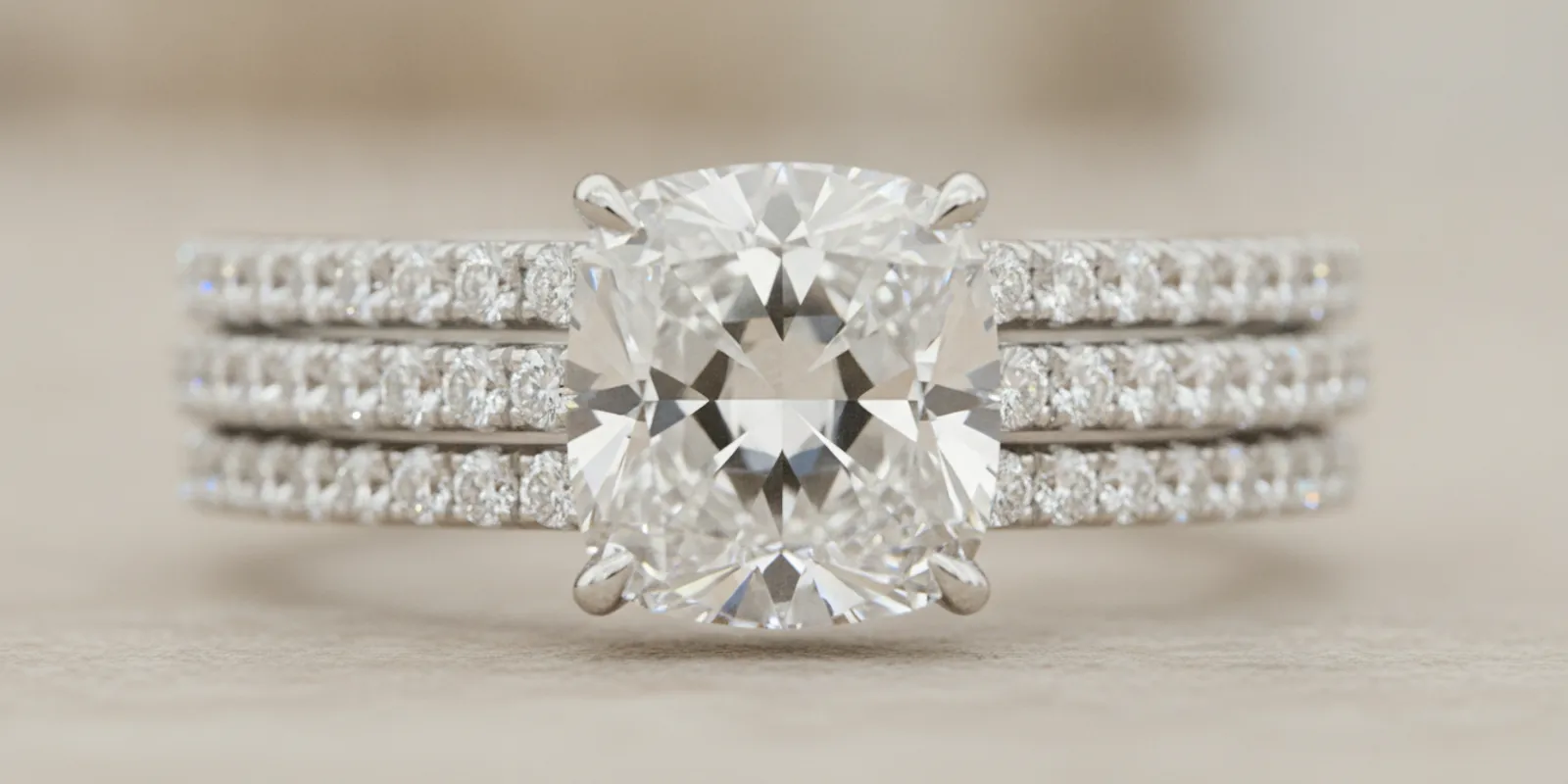
Pave Engagement Rings: A Buyer’s Guide to Style and Fit
Pave engagement rings, often written as pavé, bring a line of small accent diamonds onto the band, adding detail around the center stone without relying on a plain metal shank. The right design depends on how much sparkle you want, how the band feels on your hand, and how the ring will pair with a wedding band. Start by comparing the pavé layout and construction, not just the look from above.
Schedule a ring design appointment
What does “pavé” mean on an engagement ring?
Pavé (pronounced “pah-vay”) describes small diamonds set close together along a ring’s surface. Tiny beads of metal hold the accent stones in place. From a normal viewing distance, the diamonds can appear to form a continuous sparkling row, while close inspection reveals the individual stones and the metal between them.
Pavé is a setting treatment, not a diamond shape or center-stone style. It can be used on a slender band, a wider band, or part of a more detailed design. Some rings have pavé across the top-facing portion of the shank; others carry the accent stones farther along the sides. A pavé band can also be paired with a solitaire, halo, or three-stone center design.
That distinction helps keep comparisons clear. The center stone determines the focal shape and much of the ring’s visual balance. The pavé determines how the band contributes to the overall look. For examples of different band details, compare the Twist Pavé Ring with a classic solitaire with pavé.
How do you compare pave engagement rings by layout?
“Pavé” is often used as a broad description, but the placement, coverage, and scale of the accent diamonds can change how a ring looks and feels. When reviewing a design, turn it to the side and look at the band from above, below, and at an angle.
- Top-only pavé: Accent stones cover the visible upper section of the band. The underside remains plain metal, which can make the design feel simpler and can leave an unadorned area where the ring rests against the finger.
- Three-quarter pavé: Diamonds extend partway down the sides. This shows more of the accent stones when the hand moves, while leaving some plain metal around the lower part of the shank.
- Full or near-full pavé: Stones continue farther around the band. The look is more consistent around the finger, but resizing may be more involved because the lower shank also carries stones.
- Micro pavé: The accent diamonds are especially small and closely set. The result can look delicate, but the fine setting work deserves a careful visual inspection.
- Shared-prong or bead-set details: These describe ways the small stones may be secured. Ask to see the setting up close so you can understand the amount of visible metal and how the stones sit in the band.
Names are not always used identically across every design. Rather than choosing by label alone, ask which parts of the band contain diamonds and whether the stones continue beneath the finger. A close view or 3D rendering can help you judge coverage before a custom ring is made.
How does pavé change the look of the center stone?
Pavé adds a sparkling frame along the band, so it can make the whole ring feel more detailed than a plain-shank design. It also creates a visual path from the center setting down the finger. The center stone remains the focal point, but the accent diamonds contribute to the ring’s overall presence.
Think about the balance between the center and the band. A delicate shank with small accents can keep attention on the center stone. A wider or more elaborate pavé band makes the band itself a stronger design feature. Neither choice is automatically better; consider the wearer’s usual jewelry and whether a finely detailed or more minimal look feels right.
Metal color and band shape affect the impression, too. A straight shank gives the ring a classic outline. A twist or contoured design can add movement or create a more tailored transition into the center setting. To compare different proportions, browse examples such as the Wide Band Solitaire and the Emerald Twist Pavé Ring. These examples illustrate design differences; a product name alone does not tell you whether a specific ring will suit your hand or stack as you want.
What should you look for in the pavé setting?
Small diamonds and their settings are easiest to assess when you look closely and from more than one angle. Ask to view the ring in good light, then check these practical details:
- Even spacing: Do the accent stones appear consistently placed along the band? Look for a regular pattern that follows the ring’s shape.
- Secure-looking settings: The metal beads or prongs should be visible enough to understand how the stones are held. A jeweler can explain the construction and what routine inspection involves.
- Comfort against neighboring fingers: Check whether the sides of the setting feel smooth. If possible, try the ring on and move your hand naturally.
- Profile and height: Look at the ring from the side. The center setting and pavé shoulders together determine how high the ring sits and how it may interact with daily tasks.
- Consistent finish: Inspect the inside of the shank and the transitions between the plain metal and pavé areas. Ask about any design details that are difficult to see in a photo.
For a custom ring, request a 3D design view that shows the top, side, and underside,not only a straight-on view. That makes it easier to understand where the pavé stops, how the center setting joins the band, and what the ring’s profile will look like before the ring is created. Buchroeders’ custom engagement ring design process begins with listening, followed by selection and design, before ring creation.
Related products

This engagement ring can be created using natural or lab-grown diamonds.
View product
Our cathedral pave engagement ring setting is perfect for those who are looking for something modern, yet timeless.
View product
Introducing the 2.72ctw Round Brilliant Cut Diamond Engagement Ring, featuring a classic diamond pave band.
View productHow do pavé engagement rings compare with plain bands?
A plain band keeps the shank’s surface mostly uninterrupted. Pavé adds accent stones along that surface. The table below is a starting point for a side-by-side conversation; the feel and construction of individual rings vary.
| Feature | Pavé band | Plain band |
|---|---|---|
| Band appearance | Small accent diamonds add detail and sparkle along some or much of the shank. | Metal provides a simpler, uninterrupted band surface. |
| Where to inspect | Check stone spacing, setting details, and where the pavé begins and ends. | Check the band’s profile, finish, and how it meets the center setting. |
| Everyday considerations | Ask how to care for the accent stones and when to have the setting inspected. | Ask how to care for the metal and the center setting. |
| Wedding-band pairing | Try a straight band and a contoured option to see how they meet the ring. | A straight band may sit flush, though the center setting can still affect the fit. |
| Custom-design decision | Choose the amount of diamond coverage and the shank shape before approving the design. | Focus on band width, profile, metal, and the transition into the center. |
This is not a durability ranking. A well-chosen ring depends on the specific setting and how it is worn and cared for. If you prefer the clean look of an uninterrupted band, view a solitaire ring alongside pavé options. If you are drawn to accent diamonds but want a different arrangement, a three-stone ring with baguette side stones offers another way to frame a center stone.
Will a pavé ring work with a wedding band?
It can, but the answer depends on the engagement ring’s outline. A straight wedding band may sit flush against a straight pavé shank. A center setting that extends beyond the band can leave a gap, even when the engagement ring itself has a straight profile. A curved or contoured band may follow the ring more closely, but it is a design choice worth trying on rather than assuming from a photo.
Bring the engagement ring,or a clear side-view rendering,to a wedding-band appointment. Check the rings from the top and side while they are together. Notice whether the bands sit at the desired angle, whether a gap is acceptable to you, and whether the two rings feel comfortable as a stack.
Also think about whether you want the wedding band to echo the pavé or provide contrast. A diamond band can continue the sparkle; a plain band can make the engagement ring’s details stand out. Compare the diamond wedding band selection with eternity band styles to consider different amounts and placements of diamond coverage. Ask how the chosen band will sit next to the engagement ring, not only how each looks on its own.
How should you care for pave engagement rings?
Pavé rings have small accent stones, so regular attention to their condition matters. Follow the care advice provided for your specific ring. Avoid knocking or scraping the ring against hard surfaces, and remove it when an activity could catch or strike the setting. If a stone appears loose or the ring catches on fabric, stop wearing it and ask a jeweler to inspect it rather than trying to adjust the setting yourself.
Routine professional checks can help identify a setting concern before it becomes more noticeable. Ask what inspection schedule is suitable for the ring and which cleaning methods are appropriate. If cleaning at home, use only a method recommended for the materials and setting; do not assume that a technique safe for one piece is suitable for every ring.
Resizing is another point to ask about before buying. Changing a plain lower shank can differ from altering a band with stones extending around the finger. The feasibility and approach depend on the ring’s construction, size change, and design. If you anticipate a size adjustment or want to pass the ring down later, ask how the chosen pavé coverage could affect those plans.
How can you compare the center diamond and pavé together?
Consider the center diamond and accent layout as parts of one design, while evaluating their information separately. For a natural center diamond, ask for its grading documentation and review the details relevant to your priorities. For a lab-grown center diamond, ask for its applicable documentation as well. GIA provides diamond education and information about its grading services at gia.edu; use the report for the specific stone you are considering rather than relying on a general description.
For the pavé itself, ask what stones are used and how they are set. The center stone’s report does not describe the entire ring’s construction or answer questions about the accent stones, band coverage, or wedding-band fit. Keep those questions separate so you can compare the whole design clearly.
If you are choosing between natural and lab-grown center diamonds, neither option has to be the default. You can consider both, look at the available documentation, and decide which stone and overall ring design suit your preferences. Buchroeders offers custom engagement rings with natural diamonds certified by GIA and lab-grown diamonds certified by IGI. See the lab-grown diamond ring collection as one starting point for understanding how different center-stone choices can be presented.
What questions should you bring to a ring appointment?
A few specific questions can turn a style conversation into a useful comparison. Save the answers for each ring you consider:
- How far around the band do the pavé diamonds extend?
- What is the setting method, and how should I care for it?
- Can I see the band from the side and underneath, or review a full 3D design?
- How does the ring feel when I bend my fingers or move my hand?
- Will a straight wedding band sit flush, or should I try a contoured band?
- How does this design affect future resizing or other adjustments?
- What documentation is available for the center diamond?
- What inspection and care guidance applies to this specific ring?
Bring reference images if they help describe what you like, but use them to discuss particular features: the amount of pavé, the shank width, the center setting, or the band pairing. A useful design conversation identifies which details matter most to you and translates them into a ring that can be reviewed from multiple angles before creation.
Book an appointment to compare pavé designs
Frequently Asked Questions
Are pavé engagement rings durable enough for everyday wear?
There is no single answer for every pavé ring. Durability depends on the ring’s construction, how it is worn, and how it is cared for. Ask a jeweler to explain the setting on the specific design, when it should be inspected, and which activities call for removing it.
Can a pavé engagement ring be resized?
Resizing depends on the shank design and where the accent stones extend. A band with stones around more of its circumference may need a different approach from one with pavé only on top. Ask about the specific ring before purchase, especially if you expect a size change.
Does a pavé band have to match the wedding band?
No. You can pair it with a diamond band for a continuous detailed look or a plain band for contrast. The center setting may affect whether a straight band sits flush, so try the actual rings together or review a detailed rendering.
Is pavé the same as a halo?
No. Pavé refers to small accent diamonds set along a surface such as the band. A halo is a frame of smaller stones around the center stone. A ring may have one feature or combine both, so ask which design details are included.
Can I design a custom pavé engagement ring?
A custom design discussion can address the band shape, diamond coverage, center setting, and wedding-band fit. A full 3D rendering helps you review the proportions before ring creation. Ask which details can be tailored to your preferred design.
Start a conversation about your ring design
Choose pavé based on the way its details look and feel on your hand, how the band meets a wedding ring, and the care questions you are comfortable managing. Comparing those practical points alongside the center diamond can help you select a design with confidence.