



How to Authenticate Estate Designer Jewelry: Expert Tips
How to authenticate estate designer jewelry starts with more than a signature or a polished presentation. A confident buyer looks at the maker's mark, metal, construction, stones, documentation, provenance, and the seller's evaluation process together. This guide explains what each clue can tell you, what it cannot prove on its own, and when an expert review is the right next step. For the broader buying journey, begin with Buchroeders' guide to buying pre-owned Rolex and estate designer jewelry with confidence.
Schedule an appointment with Buchroeders to review estate designer jewelry with an expert
Why is authentication the first step in buying estate designer jewelry?
Authentication is the process of determining whether an estate designer jewelry piece is consistent with its stated maker, materials, design period, and construction. It protects the buying decision by separating what can be observed from what must be professionally verified, especially when a piece has been repaired, resized, polished, or altered.
Estate jewelry can carry genuine history, exceptional craftsmanship, and the design language of a respected house. Those qualities also make signed pieces worth examining carefully. The goal is not to judge a piece by one exciting detail. It is to build a coherent evidence trail.
- Identity: Does the design match the named house, collection, or period?
- Marks: Are the maker's mark, metal stamp, serial details, and placement consistent?
- Materials: Do the metal, stones, weight, and finish support the description?
- Construction: Do the joints, settings, clasps, closures, and underside show quality appropriate to the piece?
- History: Is there documentation or provenance that adds context without being treated as proof by itself?
- Disclosure: Has the seller clearly identified replacements, modifications, treatments, or restoration?
Authentication is therefore a layered review, not a visual guess. A professional may use magnification, reference knowledge, measurements, metal testing, gemological analysis, and market experience. Buyers should also remember that authentication and valuation answer different questions: authentication addresses what a piece is, while value depends on factors such as condition, desirability, rarity, and current demand.
What do hallmarks, stamps, and maker's marks tell you?
Hallmarks and maker's marks can identify a jewelry house, metal fineness, workshop, or production period, but a correct-looking stamp does not prove that the entire piece is authentic. The mark must be checked for typography, placement, depth, wear, and consistency with the jewelry's materials and construction.
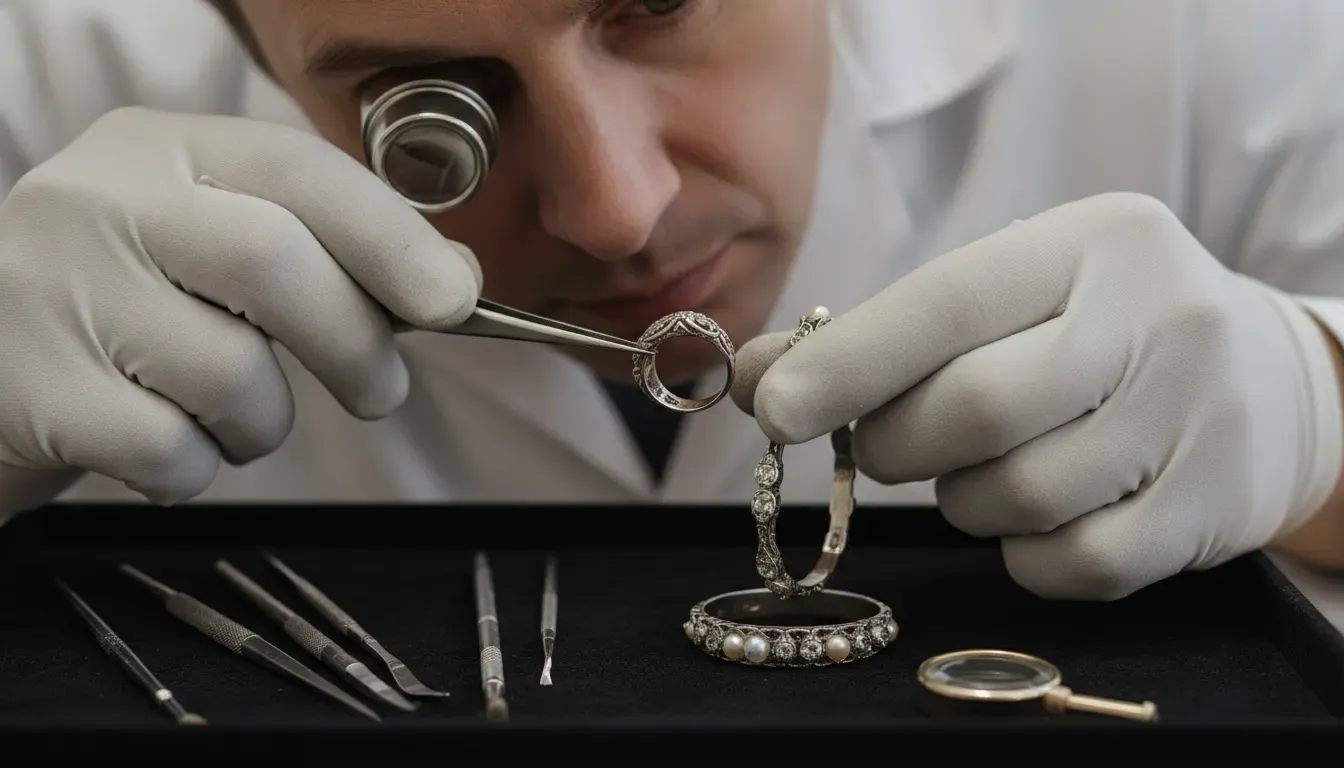
Begin with a loupe or clear macro photographs, but do not scratch, polish, bend, or disassemble the piece to find a mark. Examine the inside of a ring, the clasp or end fitting of a bracelet, the back of a pendant, and other areas where a maker would normally place an identifying mark. A mark that appears blurred, uneven, unusually shallow, or inconsistent with the surrounding finish deserves a closer review.
Which marks should a buyer record?
- The full maker's name, initials, symbol, or house signature.
- The metal stamp, such as a karat or fineness mark, when present.
- Serial or model details, without assuming an online match is conclusive.
- The exact location, orientation, spacing, and apparent age of each mark.
- Any country, assay, workshop, or date-related marks associated with the piece.
Use the mark as an entry point for research, not as a shortcut around examination. A signature can be added to a genuine-looking mounting, and a genuine mark can appear on a piece that has later been modified. The mark, design, materials, and construction must agree.
How should you examine materials and construction?
Materials and construction often reveal more than a surface signature because they show how the piece was made and how it has aged. Compare the stated metal, gemstone type, finish, weight, proportions, and mechanics with the design language expected from the named house and period.
Look closely at areas that are difficult to imitate consistently: the underside of a setting, the gallery beneath stones, the alignment of links, hinge tension, clasp engagement, solder joins, prong finishing, and the transitions between components. A sophisticated replica or altered piece may look convincing from the front while showing inconsistent engineering underneath.
| Evidence to inspect | What it may help establish | Why it is not enough alone |
|---|---|---|
| Metal mark | Stated fineness or maker information | Marks can be altered, reused, or separated from the original context |
| Weight and proportions | Consistency with a known design and material specification | Wear, repairs, and substitutions can change the original balance |
| Stone setting | Quality of construction and design-period consistency | Individual components may be genuine while the full piece is modified |
| Clasp, hinge, or screw | Mechanical details associated with a model or era | Replacement parts may be correct-looking but not original |
| Gemological report | Documented information about identified stones and characteristics | A report does not automatically authenticate the designer mounting |
For diamond or gemstone documentation, buyers can use the GIA Report Check tool to confirm a GIA report number and review the information attached to that report. That step verifies the report record. It does not, by itself, confirm that the report belongs to the exact jewelry piece or that the designer mounting is original.
Explore Buchroeders' current estate designer jewelry collection
How do documentation and provenance support authentication?
Documentation and provenance support authentication by connecting a piece to a credible history, but neither should replace physical examination. Useful records may include an original receipt, dated service record, brand-issued document, prior appraisal, gemological report, or a clear ownership history that can be checked for consistency.
Read every document for the same details you see on the jewelry: maker, model or collection, metal, measurements, stone description, serial information, and dates. Discrepancies do not automatically mean a piece is inauthentic. They may reflect a later resize, replacement stone, restoration, or an appraisal written for a different purpose. They do mean the discrepancy should be explained before purchase.
What questions should you ask about records?
- Who issued the document, and what exactly did that person or organization examine?
- Does the document describe the complete piece or only an individual stone?
- Do the measurements, metal, marks, and serial details match the jewelry in front of you?
- Are repairs, replacements, treatments, resizing, or refinishing disclosed?
- Can the seller explain how the piece entered the current collection?
- What written terms apply if a material detail is later found to be different from the description?
The U.S. Federal Trade Commission's Jewelry Guides explain why descriptions should accurately represent a jewelry item's metal, gemstone, treatment, quality, and other material characteristics. For buyers, the practical lesson is simple: ask for clear descriptions, compare them with the piece, and request an explanation for any omission or inconsistency.
Related products

Comes with the original box, certificate of authenticity, and receipt.
View product

Comes with the original box and certificate of authenticity.
View productWhat red flags can signal a misrepresented estate piece?
A red flag is not always proof of a problem. It is a reason to pause, ask a more precise question, or request a qualified review before committing to a purchase. The strongest warning signs usually involve several inconsistencies rather than one small imperfection.
- Signature-only confidence: The seller treats one stamp as conclusive and cannot explain the rest of the piece.
- Unclear description: The listing avoids naming the metal, stones, modifications, or condition.
- Document mismatch: Records describe different measurements, materials, dates, or identifying details.
- Unexplained uniformity: Wear, patina, and finishing do not make sense together for the stated age.
- Over-polished marks: Hallmarks are softened or partially removed, making the original detail difficult to assess.
- Replacement parts not disclosed: A clasp, stone, shank, screw, or other component appears inconsistent with the rest.
- Pressure to skip review: The buyer is discouraged from asking questions or obtaining an independent opinion.
- Photos that hide key areas: The underside, clasp, hallmark, or setting is never shown clearly.
Be especially careful with claims that rely on scarcity, urgency, or celebrity association instead of evidence. A beautiful piece can still deserve a slower decision. The most trustworthy buying experience makes room for careful questions and explains what has been verified, what is documented, and what is not known.
Why does a vetted estate jeweler provide stronger buyer protection?
A vetted estate jeweler provides stronger protection because authentication is built into the buying process rather than left entirely to the customer. The jeweler can examine the piece in person, document condition and modifications, explain the evidence, and connect the item's description to a professional standard of review.
Look for a buying process that includes:
- Clear identification of the designer, materials, and known condition.
- Disclosure of replacement components, restoration, resizing, and treatments.
- Staff who can explain the difference between a maker's mark, a gemological report, and an appraisal.
- Time to inspect the piece and ask questions before making a decision.
- Written documentation that remains connected to the exact item being considered.
- A clear path to professional guidance when the evidence requires specialized analysis.
Buchroeders Jewelers serves buyers through an expert-guided showroom experience in Columbia, Missouri, with estate and designer inventory connected to the broader Diamond Banc relationship. Because estate inventory rotates and a desirable piece may be available only briefly, the best approach is to ask about the exact item currently under consideration rather than rely on a generic product description. The estate Cartier collection, estate Tiffany & Co. collection, and Shop By Designer collection are useful places to see current availability, while an appointment allows the team to discuss the piece's marks, materials, documentation, and condition in context.
For the broader framework that connects authentication, condition, provenance, and confident buying across secondary-market categories, revisit Buchroeders' secondary-market buying guide.
Schedule a consultation before choosing an estate designer jewelry piece
Frequently Asked Questions
Q: How can I authenticate estate designer jewelry?
A: Examine the maker's mark, metal, construction, stones, documentation, provenance, and condition together, then have the piece reviewed by a qualified jewelry professional. No single stamp, photograph, or document proves authenticity by itself.
Q: Does a designer hallmark prove a piece is authentic?
A: No. A hallmark is an important clue, but it must match the piece's design, materials, placement, construction, and period. Marks can be altered, added, or separated from an original component, so a complete review is essential.
Q: Can a GIA report authenticate the entire jewelry piece?
A: A GIA report can document identified gemstones and their characteristics, and the GIA Report Check tool can confirm the report record. It does not automatically authenticate the designer mounting, maker's mark, or originality of every component.
Q: What documents should come with estate designer jewelry?
A: Helpful documents may include a receipt, service record, brand-issued document, prior appraisal, gemological report, or ownership history. Compare every record with the physical piece and ask the seller to explain any mismatch or undisclosed modification.
Q: Should I buy estate designer jewelry without seeing it in person?
A: In-person review is the strongest option when the piece's authenticity, condition, fit, or construction is important to the decision. If you are considering an online purchase, request clear images of marks and undersides, complete documentation, and a professional inspection path before proceeding.
Schedule an appointment with Buchroeders Jewelers to examine estate designer jewelry with confidence
