



Custom Engagement Ring Cost: A Complete Pricing Guide
Planning a custom engagement ring can feel difficult when you do not yet know which choices affect the price. The good news is that customization gives you more control, not just more decisions. You can shape the ring around your priorities, whether that means emphasizing the center diamond, choosing a distinctive setting, or investing in hand-finished details.
Start designing your custom ring
The custom engagement ring cost depends primarily on the diamond's cut, color, clarity, and carat weight, along with the setting style, metal, design complexity, and craftsmanship. There is no universal spending rule, so the right budget is one that reflects your preferences and financial comfort.
At Buchroeders Jewelers, the process begins by listening to what matters most to you, then balancing those priorities through stone selection and design. Understanding how each element contributes to the final price makes it easier to compare options confidently and create a ring that feels personal from the start.
Custom Engagement Ring Cost: What Determines the Cost of a Custom Engagement Ring?
A custom ring gives you control over where your budget goes. The final price is shaped by four primary elements: the center diamond, the metal, the setting design, and the craftsmanship required to bring the design to life.
1. The center diamond
For many engagement rings, the center stone accounts for roughly 50% to 70% of the total cost. Its price is influenced by the 4Cs: cut, color, clarity, and carat weight. Cut affects how effectively the diamond returns light, while color and clarity describe qualities that can influence appearance and rarity. Carat weight also matters, but pricing is not always linear. Stones near popular weight thresholds can carry a higher price than a slightly lighter diamond with a similar visual presence.
That makes the diamond an important place to make intentional tradeoffs. You might prioritize an excellent cut for brightness, choose a size that suits the setting and your hand. Or adjust color and clarity within a range that still looks beautiful to you. A knowledgeable jeweler can help you compare those choices rather than treating a single specification as the goal. GIA's diamond pricing guidance explains how these factors work together.
2. Metal choice
Platinum generally costs more than gold because of its purity, durability, and material properties. Depending on the design and market conditions, choosing platinum instead of gold may add approximately $300 to $1,000 or more. Gold also offers meaningful choices, including color and karat, so the decision is not simply about choosing the least expensive option. Consider the look you want, how the ring will be worn, and how the metal complements the center stone.
3. Setting style and complexity
A simple solitaire uses fewer materials and less bench time than a halo, pavé, or highly detailed setting. More accent diamonds, delicate beadwork, hand-finished details, unusual proportions, and intricate under-gallery work can all increase the cost. The setting should protect and support the center stone, but it also determines much of the ring's character. Simplifying one design feature can free budget for a larger center stone, a premium metal, or another detail that matters more to you.
4. Craftsmanship and labor
Craftsmanship covers the design development, casting, stone setting, metal finishing, and quality checks. Intricate designs or rings that require carefully matched stones take more skilled labor. A straightforward custom design typically takes at least two weeks, while a complex piece may require five to six weeks or longer, according to GIA's custom engagement ring guidance. That time reflects the work involved, not an arbitrary surcharge.
Custom Engagement Ring Setting Options and Price Ranges
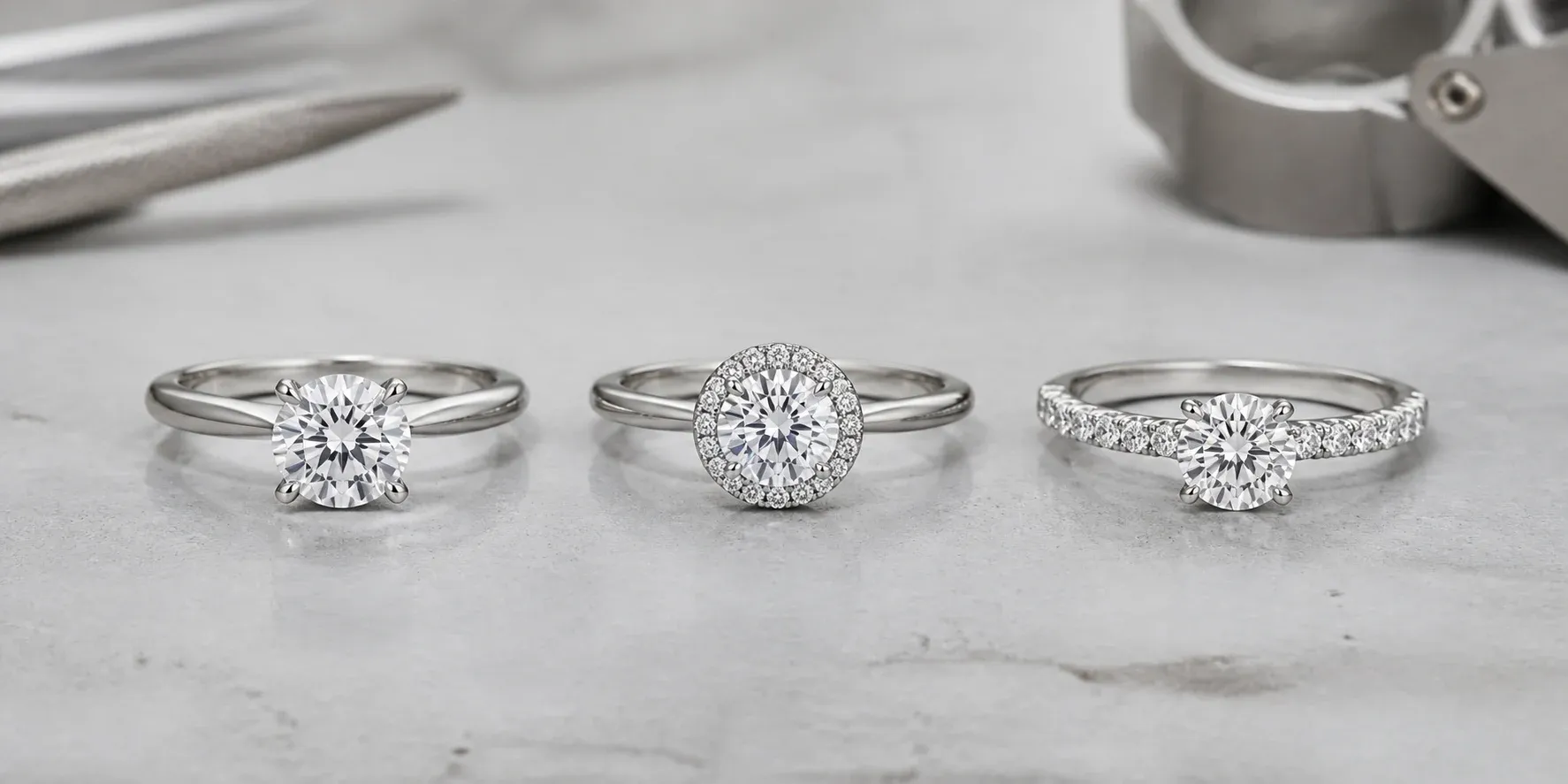
The setting determines how your center diamond looks, how securely it is held, and how much detail goes into the finished ring. Buchroeders offers more than 30 signature setting styles, with settings generally ranging from $1,360 to $2,500 and beyond. That range gives you meaningful design control before you select the center stone.
Solitaire settings: a focused, affordable foundation
A solitaire holds one center diamond with minimal surrounding detail. Because it uses less metal and fewer accent diamonds, it is often the most affordable setting style. It also puts attention on the center stone. Making it a practical choice when you want to direct more of your budget toward cut, color, clarity, or carat weight.
Halo and hidden halo settings: more presence around the center
A halo surrounds the center stone with smaller diamonds, creating a broader look from above. A hidden halo adds that detail beneath the center stone, so the ring has extra sparkle without making the surrounding design the main focus. These settings require additional stones and more precise setting work, which can increase the price compared with a simple solitaire.
Pavé and vintage-inspired settings: detail drives craftsmanship
Pavé settings use closely set accent diamonds along the band. Vintage-inspired designs may add milgrain, engraving, sculpted edges, or other refined details. Each element affects the labor involved, so two rings with similar silhouettes can have different prices depending on the amount and complexity of the handwork. Explore Buchroeders' engagement ring styles to compare the design directions available.
How metal choice changes the setting price
Metal is another important part of the custom engagement ring cost. Platinum typically carries a premium over gold because of its material properties and density. Depending on the design and current material costs, the difference between platinum and gold can be approximately $300 to $1,000 or more. Fourteen-karat white, yellow, and rose gold offer different colors and finishes at a generally lower setting cost. Eighteen-karat gold contains a higher percentage of pure gold and may carry a higher price than 14k gold.
A thoughtful consultation can balance the setting style, metal, and center stone around your priorities. Choosing a simpler setting does not mean sacrificing a custom look. It can be the clearest way to reserve more of your budget for the details that matter most to you.
Diamond Costs: Natural vs. Lab-Grown
The diamond is often the largest part of an engagement ring budget, but there is no single right choice for every couple. Natural and lab-grown diamonds can both be evaluated through the same four quality factors: cut, color, clarity, and carat weight. Those factors influence the price per carat, so two diamonds with the same carat weight may have noticeably different prices. The Gemological Institute of America explains that the 4Cs are central to diamond pricing, alongside the setting and metal selected for the ring. Learn more about the 4Cs and engagement ring pricing.
| Consideration | Natural diamond | Lab-grown diamond |
|---|---|---|
| Typical price relationship | Pricing reflects a naturally formed diamond and varies widely by the 4Cs, shape, grading, and market conditions. | Often costs about 40% to 70% less than a comparable natural diamond, depending on the stone and market. |
| Available budget range | Buchroeders natural diamond engagement rings range from $3,995 to $675,000, depending on the complete ring and selected stone. | The lower price per carat may allow more flexibility within the same overall ring budget. |
| Cut | A well-executed cut improves light performance and can make a diamond appear more lively, which affects value. | Cut remains important. A lower price does not replace the need to compare proportions, finish, and visible sparkle. |
| Color and clarity | Higher color and clarity grades generally increase price, although the best balance depends on what you can see and value. | The same grading considerations apply. You may choose to direct savings toward carat weight, a setting, or a higher grade. |
| Carat weight | Price per carat can rise at widely recognized weight points, such as 1.00 carat, even when the visual difference is subtle. | Carat weight still affects price per carat. Comparing just below a popular weight point may create additional design flexibility. |
Think of these differences as planning tools, not a verdict. If you prefer a natural diamond, you can adjust shape, color, clarity, carat weight, or setting complexity to stay aligned with your budget. If you prefer a lab-grown diamond, the lower cost per carat may give you more room for a larger center stone or a more detailed setting. In either case, the goal is a ring that reflects your priorities clearly.
For inspiration, explore the 1896 Collection and compare how stone choices work with different design directions.
The Custom Design Process and What It Costs
A custom ring should feel personal from the first conversation, not like a series of surprises on an invoice. At Buchroeders, the process is designed to give you clear choices about the diamond, setting, metal, and craftsmanship while keeping your priorities and budget in view. You can review the custom engagement ring process before your consultation.
-
We Listen First
Your consultation begins with a diamond specialist. You will discuss the look you have in mind, how the ring should fit your partner's style, and the budget you want to respect. This conversation helps establish the right starting point rather than pushing you toward a preset design. Your specialist can also explain how diamond cut, color, clarity, and carat weight affect the stone's price, along with how the setting and metal influence the total.
-
Selection and Design
Once the direction is clear, you review suitable diamond and setting options. The design team then develops a 3D CAD model and digital rendering so you can see the proposed ring before it is made. This is where custom design becomes practical: proportions, profile, stone placement, details, and metal can be refined until the design feels right. Adjustments happen during this stage, when changes are easier to make than after production begins.
Pricing is discussed as the design takes shape. A more intricate setting, additional stones, a particular metal, or a higher-value center diamond can change the total. But each element should be explained before you approve the design. The goal is transparent pricing with no hidden fees, so you understand what you are choosing and why it affects the investment.
-
Ring Creation
After you approve the design, master jewelers build the ring to exacting standards. Custom craftsmanship includes the labor involved in creating the piece, setting the stones, and finishing the metal. The time required depends on the design's complexity. A straightforward ring generally takes at least two weeks, while a complex piece can take five to six weeks or longer. Planning for a typical two-to-six-week window gives you room for careful craftsmanship and any design-specific requirements.
The value of this approach is control. You are not paying for customization as an abstract premium; you are making informed decisions about the details that matter most to you. A Buchroeders specialist can help you balance those choices so the finished ring reflects both your relationship and your financial comfort.
Building a Custom Engagement Ring Budget That Works for You
A useful budget starts with your priorities, not a rule about what an engagement ring is supposed to cost. For perspective, many couples in the United States spend between $2,000 and $6,000. Our engagement ring budget guide offers additional context as you set a comfortable range.
Custom design can give you more control over that range than choosing a ready-made ring. You can decide whether to direct more of the budget toward the center diamond, a distinctive setting, the metal, or details that make the ring personal. The following tiers are starting points rather than fixed price categories.
$2,500 to $5,000: Focused choices with room to personalize
This range can support a refined custom ring with a simpler setting and a carefully selected center stone. A lab-grown diamond may allow you to consider more size or a higher combination of cut, color, and clarity while staying within the same budget. A classic solitaire, slim band, or understated accent detail can keep craftsmanship and proportion at the center of the design.
If you prefer a natural diamond, you may choose a smaller center stone or simplify other elements to keep the total aligned with your priorities. Starting with a clear must-have list helps your jeweler show meaningful options instead of presenting designs that exceed your comfort level.
$5,000 to $10,000: More flexibility for stone and setting
At this level, you can explore a broader selection of natural diamond options alongside lab-grown diamonds. The budget may also accommodate a more detailed setting, such as a halo, pavé accents, or a shaped band designed to pair with a future wedding ring. The balance depends on how much of the total goes toward the center stone and how much goes toward metal and design work.
Ask to compare versions of the same concept. Seeing a design with different diamond choices or metal options makes the trade-offs easier to understand and keeps the decision grounded in value rather than guesswork.
$10,000 and above: Larger stones and intricate design
A higher budget can open the door to a larger natural diamond, platinum, hand-finished details, or a more intricate one-of-a-kind design. It does not mean every element needs to be maximized. You might prioritize a particular diamond shape, a platinum setting, engraving, or details inspired by a family heirloom, then keep the remaining elements intentionally restrained.
Financing may make a custom project easier to plan without changing your agreed budget. Buchroeders offers financing options through Wells Fargo and Affirm, subject to their terms and approval. Review the payment schedule, interest, and total repayment before choosing a plan. A thoughtful custom ring should reflect both your relationship and a financial decision you can enjoy with confidence.
Frequently Asked Questions
How should I set a budget for a custom engagement ring?
Start with a monthly or total amount that feels comfortable, then share that range before selecting a diamond or setting. Your jeweler can adjust the 4 Cs, metal, setting details, and design complexity to keep the ring aligned with your priorities. There is no universal spending rule, so personal style and financial comfort should guide the decision.
Can a custom ring be designed to cost less?
Yes. Custom design gives you control over the features that matter most. You might choose a simpler setting, a different metal, or a diamond with balanced 4 Cs rather than maximizing every grade. A lab-grown diamond may also provide a different way to allocate your budget, while natural and lab-grown options can both be evaluated according to your preferences.
What makes a custom engagement ring more expensive?
The largest cost differences usually come from the center diamond, setting style, metal choice, and the amount of handwork required. Intricate pavé, unusual shapes, matching stones, and complex structural details require more design and craftsmanship than a straightforward setting. Platinum is generally priced higher than gold because of its durability and purity.
How long does it take to make a custom engagement ring?
A straightforward design typically takes at least two weeks. While a complex piece or one requiring matched stones can take five to six weeks or longer, according to the Gemological Institute of America. Ask about the production schedule during your consultation, especially if you are planning a proposal date or need time for final sizing.
Are financing options available for a custom ring?
Financing can help you spread payments rather than changing the design before you understand the full cost. Buchroeders offers financing through Wells Fargo and Affirm. Review the available terms, interest, and payment schedule carefully so the plan fits your overall budget.
Ready to Start Designing Your Custom Ring?
A clear budget is a helpful starting point, but your ring should reflect your priorities, from the diamond to the setting and metal. Start designing your custom engagement ring with Buchroeders' Custom Ring Builder today, then bring your ideas to the next step with a plan that feels right for you.
